
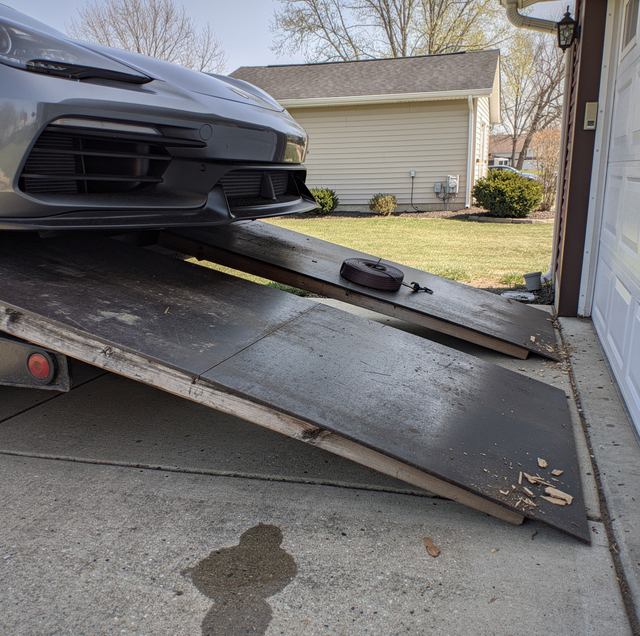
A lowered or low-clearance car gets damaged during towing at specific points, not everywhere at once. The front lip, air dam, or splitter reaches the ground first when the slope underneath it changes, and the underbody and exhaust cross that same transition right behind it. Side skirts can scrape a curb, a truck's fender or its own loading rails, and a rear diffuser meets the transition again on the way off. That happens where a change in slope meets a car with little room to give underneath it, not simply because the car sits low. The answer turns on the angle the car meets at the bed and the points used to pull it on and hold it there, whatever truck is sent, and both of those change from one loading job to the next.
Each stage of getting a low car onto the truck and back off puts a different part of it at risk, and each stage has its own fix.
| Stage | What Can Scrape or Bend | What Changes It |
|---|---|---|
| Lining up to the bed | The front lip catches the truck's rear frame or a curb behind it if the approach isn't square | A straight, centered approach with the bed already lowered to the ground |
| Where the bed meets the ground | The front air dam or splitter digs in at the break between the ramp and the flat bed | The bed tilted as flat as it goes, or wood or ramp extensions laid across that break |
| Winching the car on | The underbody catches if the car is pulled at an angle instead of straight up the center | A straight winch line and a controlled, even pull instead of a fast one |
| Where the winch hook attaches | A control arm, tie rod or other suspension part bends or cracks under the pull | A tow hook or tow eye built to take that load, used in place of a suspension part |
| Tying the car down | A chain cinched over a rocker panel or body lip dents or creases it | A wheel strap looped over the tire and wheel instead of a chain over the body |
| Unloading | The rear diffuser or exhaust catches backing down the same break in the slope | The same shallow ramp or extensions used again, with the bed lowered slowly |
Why a Lowered Car Rides on a Flatbed
An all-wheel-drive car rides on a flatbed because towing it on its own wheels can spin parts of the drivetrain that are designed to be driven by the engine, not the road. A low-clearance or lowered car rides on a flatbed for a different reason, built around ride height rather than drivetrain. Any method that leaves the car resting on its own wheels for any part of the trip can put the lowest points of the body close enough to the pavement, a ramp, or a curb to make contact somewhere along the way. A flatbed carries the whole car above the road once it is aboard, so the only places left where clearance is tight are the short transitions getting on and off, not the distance in between.
The Approach Angle and What Eases It
The tightest spot in the whole load is the transition where a slope changes: street to ramp, ramp to flat bed, or a driveway apron rolling into the road. A car's front overhang and the height of its lowest point decide how much of that change in slope it can cross before the lip or the pan underneath makes contact, and a shorter front overhang or a car sitting higher crosses the same transition with room to spare. Two things ease that transition without changing the car at all. Laying the truck's own bed as flat as it will go against the ground removes part of the break in the slope before the car ever reaches it. Wood blocks or ramp extensions laid across what's left of that break turn one short, steep step into a longer, shallower rise, so the lip rides up and over it instead of into it. Where a front splitter sits especially low, or the loading spot itself carries its own slope, the crew may move the car to load from a flatter stretch of curb or driveway rather than stack both slopes on top of each other.
Winching and the Car's Own Tow Points
Once the bed is down and the transition is eased, the car is winched aboard on a straight line, centered on the bed, at a controlled, even pace rather than pulled quickly. Nobody rides in the car or pushes it from behind while the winch line is doing that work; the winch alone carries the load, and a hand or a foot too close to a cable under tension is not a safe place to be. Where the winch hook attaches decides what takes the strain. Cars carry a factory tow hook or a removable tow eye that threads into a bumper insert built to take a straight pull; every car has that designated point somewhere on it, and a crew locates it before hooking rather than guessing. What that point is not is a suspension arm, a tie rod, or a piece of the subframe. Those parts are built to carry the car's weight and steer it, not to be pulled on from the angle a winch line applies, and hanging a hook there can bend or crack a part that ordinary driving does not stress that way.
Wheel Straps Versus Chassis Chains
How the car is held down for the ride is the second place a low car can be marked. A wheel strap loops around the tire and wheel, pulling snug over the tread, so the load is carried by a part built to take weight and pressure in the first place. A chain hooked to a frame point or looped over a rocker panel does the same job on a car with room underneath it. Still, a lowered car leaves less room underneath to route a chain without it resting against a splitter, an exhaust tip, or the underside of a rocker panel, and a chain pulled tight against painted metal or plastic trim can crease or crack it. Wheel straps sidestep that problem, since the pull they carry is borne by the tire and wheel rather than the body.
A car shifting on the bed or a winch cable under load can move fast enough to strike anyone standing near the bed's edge, so the crew runs the winch and handles the car alone while it loads or unloads.
Air Suspension, Coilovers and Ride-Height Settings
A car built with adjustable air suspension or coilovers can have one more option: raising the ride height before it is ever winched aboard. Doing that can open up the same transition that would otherwise catch a lip or a splitter, so long as the system still holds and the car is parked and stationary when it's raised, not moving up the ramp or hanging on the winch line. Where the system isn't holding air, isn't working, or the car has no adjustable height to begin with, the ramp extensions and the flattened bed angle do the same job as the suspension would. A roadside jack is no substitute for either one: a car propped on a jack on a road shoulder can slip or drop while a loading angle is worked around it, so that step belongs to the ramp gear.
What to Tell the Dispatcher About the Car's Clearance
Naming the car as lowered or aftermarket-lowered on the first call is one of the details that gets a truck with the right bed, ramps and straps sent out, rather than standard gear that then needs the correct pieces brought once it's already on scene. A car that's stalled or broken down low to the ground on a shoulder is a separate concern in the meantime: it's waited for off the roadway, clear of moving traffic, with hazards on, rather than nursed up over a curb or a steep driveway transition by the driver trying to gain clearance before the truck arrives.
Frequently Asked Questions
No. A car that won't start is winched on the same way, straight and centered on the bed. The difference is that nothing on the car's own power helps ease it through the transition, so the winch carries the entire pull.
It can. The end that meets the ramp first crosses the break in the slope before its own wheels reach the ramp, so a car whose front lip hangs low and far forward can be loaded rear-first, putting the rear overhang across that break instead.
A lip held on with tape has no fixed edge, so it can peel back or fold under as it meets the ramp, where a bolted lip holds its shape. An edge that is already lifting is worth naming to the crew before the car is loaded.
Yes, in a different spot than the front end. Flares or wheels that sit proud of the fenders can be the first part of the car to reach a truck's side rail as the car centers on the bed, so the crew watches that width going up as well as the height of the front end.
Yes. A soft or underinflated tire drops the corner of the car sitting on it, and on a car that's already lowered, that drop comes out of the clearance the ramp extensions and the flattened bed are set to protect.
It matters. A block or extension that's too short leaves a second, smaller break in the slope right where the first one ends, and that can catch the car a second time. The extension has to run long enough to blend the whole transition into one shallow rise instead of two short ones.
Arrange a flatbed tow for the lowered car — a bed tilted flat, ramp extensions and wheel straps sized to a car sitting low. Auto Wreckers Milwaukee Towing & Recycling serves Milwaukee, West Allis, Waukesha, and the surrounding southeastern Wisconsin metro. Call (414) 441-2719.