
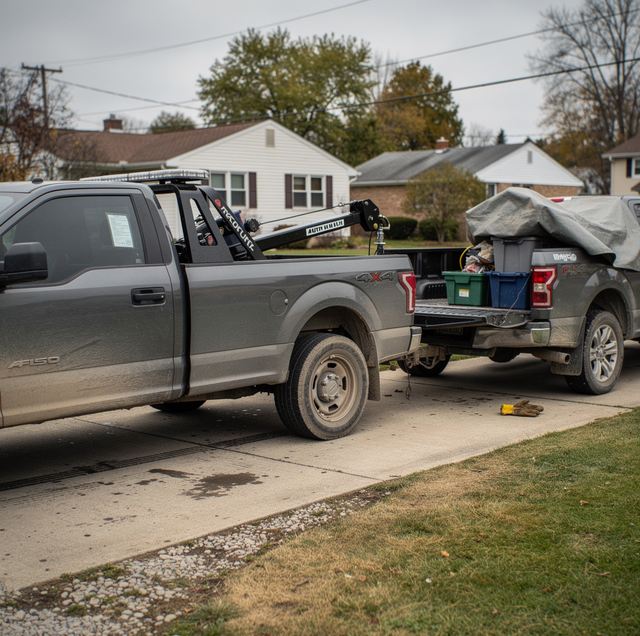
When you call about a vehicle that needs to move, you almost always know one thing for certain: it looks big. What you usually don't know is that "big" isn't the detail that decides whether the job needs a heavy-duty tow truck. Classification runs on a narrower, more specific set of facts: how much the vehicle actually weighs against what the truck is rated to handle, where that weight sits along the frame, whether the vehicle is upright and reachable or off the roadway in a position that has to be corrected first, and what the recovery has to accomplish before anything gets towed at all. A short pickup hauling a loaded trailer can cross into heavy-duty territory that a much longer, empty box truck never reaches, and none of that shows up in a glance from the shoulder. It shows up once someone who knows what to check runs those factors against the specific vehicle in front of them.
Gross Vehicle Weight Against the Truck's Own Rated Capacity
The starting point is actual gross weight: what the vehicle weighs right now with its cargo, hitch load, and passengers, not its curb weight when it rolled off the line empty. The gross vehicle weight rating on the door jamb sticker is the most a vehicle is built to carry, and a pickup or van that sits well under it on a normal day can be loaded right up to that limit. That loaded figure is what a tow operator has to work against.
On the truck side, rated capacity isn't a single number attached to one part. It's a system limit. The boom, the underlift, the chassis, the axles, and the hydraulics all have to hold together at whatever angle and distance the specific pickup requires, and the truck's real capacity in that moment is set by whichever piece of that system is closest to its limit, not by the largest spec printed on a brochure. A truck rated to handle a given weight in a straight, low pull may be working closer to its limit on an angled pull off a soft shoulder. That's why the real answer to "can this truck take it" comes from confirming loaded weight and pull angle against the truck's rated system, not from eyeballing the vehicle.
Confirm loaded weight, not curb weight: Tell the dispatcher what's actually loaded on the vehicle right now, rather than relying on a factory spec sheet, since that's the fastest way to get the classification right the first time.
Wheelbase and Length Against Boom Reach and Deck Length
Weight isn't the only measurement that matters. A vehicle's wheelbase and overall length change what equipment can physically do the job, independent of how much it weighs. The integrated boom and underlift on a truck have to reach the pickup points on the frame without extending past a safe working range, and a flatbed-style deck has to hold the full length of the vehicle without dangerous overhang once it's loaded and moving.
That means a long, comparatively light vehicle can force the use of heavier equipment even though its actual weight would sit well within a lighter truck's rated capacity, because a standard truck's lift points and deck length simply aren't built to reach that far. The reverse also happens: a shorter, unusually heavy vehicle can max out a truck's capacity before length is ever the issue. Weight and geometry are two separate thresholds, and a vehicle only needs to meet one to require heavy-duty equipment.
Off the Roadway or on Its Side: Recovery Versus Transport
Whether your vehicle needs a tow or a recovery changes what shows up on scene, and what matters is what a recovery adds to the equipment call, not a separate set of definitions. Getting a vehicle back onto stable ground, out of a ditch, off an embankment, or upright again after it lands on its side or roof draws on the rated capacity that a straight tow of the same vehicle would never reach. A vehicle that sits comfortably within a truck's rated pull for a normal hookup can push that same truck toward its limit once winching or lifting at an angle is added, which is why the heavy-duty question often gets decided by the recovery phase, not the tow that follows it.
Recovery work is where rotator recovery units come into play. A rotator can rotate through a full range and side-load, which lets it upright and reposition a vehicle that's landed off its wheels without needing to drag it into a normal position first. Recovery also draws a line between winching and lifting: winching uses cable tension to pull or reposition a vehicle, dragging it out of a ditch or rolling it upright, while lifting supports its weight vertically via the boom or underlift once it can be safely raised. A single recovery often uses both, in sequence: winch the vehicle into a stable position first, then lift and secure it for the actual tow.
A winch line under load stores enough force to cause serious injury or death if it fails. Recovery rigging and winching are jobs for a trained operator, never something a driver or bystander should attempt at the scene.
Commercial and Equipment Classes That Change the Job
Size aside, certain classes of vehicles and equipment have structural differences that automatically push a job into heavy-duty territory: box trucks, buses, tractor units, RVs, and construction or yard machinery. A lot of that comes down to how the vehicle is built to stop and steer, not just how much it weighs.
Heavier commercial units, such as tractors, buses, and larger straight trucks, typically use air brakes rather than the hydraulic system found in passenger vehicles, while vans, light box trucks, work pickups, and many medium-duty straight trucks use the same hydraulic system as a car. Air brakes are designed to lock on automatically when air pressure drops, which is a safety feature under normal driving, but it means a vehicle with a dead air system can't simply be pulled the way a car in neutral can. An operator on a tractor unit also has to check drive-axle handling, since a locked, damaged, or disconnected drive axle changes which equipment can move that unit at all. An RV or bus with a different frame and axle layout adds its own pickup points and balance considerations, and construction or yard machinery often isn't built to be towed conventionally at all, requiring rigging suited to that specific equipment.
When one truck isn't enough: Some recoveries need more than one truck even when a single unit's rated capacity would seem to cover the vehicle's weight on paper. An overturned tractor-trailer is a common example: a rotator may be needed to upright and stabilize the unit, and a separate truck completes the actual tow once it's back on its wheels. That call comes from the operator reading the specific scene, not from a fixed rule tied to vehicle type.
How Cargo and Load Change the Answer on the Same Vehicle
The same truck can fall on either side of the heavy-duty line depending on what it's carrying that day. An empty box truck and a fully loaded one are a different classification question even though the vehicle itself hasn't changed, because gross weight includes whatever is inside it.
Load shift adds another layer. Cargo that has shifted during a crash or breakdown changes the vehicle's balance in ways that aren't visible from the outside, and a shifted load can make it unsafe to lift or tow until it's addressed.
That's part of why classification isn't a one-time lookup against a spec plate. It's a judgment made against the vehicle and its cargo as they actually sit at the scene, which can change the plan even for a vehicle type that an operator has handled many times before.
Access Constraints That Rule Out a Big Truck Anyway
Weight and geometry can point straight at heavy-duty equipment and still run into a scene that heavy-duty equipment can't physically reach. Low-clearance structures, weight-restricted bridges or roads, and tight urban approaches all limit what can get to the vehicle in the first place, regardless of what the vehicle itself needs.
This is where the difference between the tow and the recovery that precedes it matters most. Getting a vehicle out from under a low clearance or off a restricted-access surface sometimes calls for smaller, more maneuverable equipment to extract it first, with the heavier truck staged nearby to transport it once the vehicle can be reached. Access and capacity are separate questions, and a scene can fail the access question even after it's already cleared the capacity one.
When you call, describe exactly where the vehicle is sitting: a parking structure, a narrow alley, a soft shoulder, an embankment. That detail alone can change which truck gets sent before anyone talks about weight.
What Only Becomes Clear Once the Truck Is on Scene
A phone call can only tell you so much. You can describe how the vehicle looks, roughly where it's sitting, and what happened to put it there, but a few things stay unsettled until an operator is standing next to the vehicle. Whether a recovery point is actually sound or already bent, how much the load inside has shifted, whether a wheel truly won't turn or is just stiff, and how firm the ground really is are all questions a phone description can narrow down but not settle.
That's why the plan you hear when you call is a starting point, not a fixed answer. An operator arriving on scene may add a second truck, switch from a straight hookup to a winch-out, or bring cribbing that wasn't part of the original plan because something about the vehicle or the ground didn't match the description. That doesn't mean the first assessment was wrong; it means classification finishes on scene, and the equipment call stays open until the operator can see the vehicle themselves.
Frequently Asked Questions
Yes, but not by simply releasing the brakes the way you would in a car. Commercial air brakes use spring brake chambers that lock on automatically when air pressure is lost, so a trained operator has to cage those chambers or supply temporary air through a glad-hand connection before the vehicle can be moved, with it chocked the entire time. Caging a spring brake releases a large amount of stored spring force, so this is considered trained work only; a driver should never attempt to use it to move the vehicle.
Yes. Lifting the front of a towed vehicle shifts part of that vehicle's weight forward onto the recovery truck's drive axles, and the truck's steer axle comes off the ground at the same time, changing how the truck handles and brakes. Operators account for this by adjusting underlift extension and truck ballast, rather than just checking the rated lift capacity.
Not necessarily. A tractor can be separated from its trailer by pulling the fifth-wheel release handle, which opens the coupling's locking jaws, allowing the trailer's kingpin to be released so each unit can be recovered or towed independently. This is common when only one half of the combination is disabled.
Yes. A rotator has to be set up on its outriggers before it takes any load, since the outriggers allow it to swing a vehicle out to the side without tipping the truck. Once it's rigged, the operator keeps the load within the capacity chart for each boom angle, extension, and swing position, because the truck's lifting capacity drops as the boom reaches farther out and as it swings away from its strongest position over the rear.
Operators place cribbing, blocks of wood or composite material, under the vehicle to support and stabilize it on soft or uneven ground before winching or lifting begins. Cribbing prevents further movement while the recovery is set up.
Often, yes. A second, lighter line is rigged to a separate anchor point as a tag line, and its job isn't to help pull the vehicle. It holds the vehicle steady and keeps it from swinging or rotating out of control as the main line brings it up, which matters most on a heavy unit coming up off uneven ground or out of a rollover position.
Get the right truck sent — describe what you're looking at, and the operator will confirm the rest once they can see the vehicle for themselves. Auto Wreckers Milwaukee Towing & Recycling serves Milwaukee, West Allis, Waukesha, and the surrounding southeastern Wisconsin metro. Call (414) 441-2719.