
The temperature dropped overnight, and you are sitting in the driver's seat with the key turned and nothing going the way it should. Maybe you hear a single click. Maybe the dash lights flicker and fade. Maybe the engine turns over slowly and heavily and never catches. Whatever the sound, the question is the same one that decides your whole morning: is this a battery you can jump, or is something broken that needs a tow?
Getting that call right saves time and money. A jump on a car that only needs a jump has you moving in five minutes; on a car with a bad starter or a locked-up engine, it only drains a good Samaritan's battery and delays the tow you needed anyway. The car usually tells you which one it is if you know what to listen for.
A Quick Read on What the Symptoms Mean
Turn the key, notice exactly what happens, and match it to the closest row.
| What you hear or see | Likely cause | Jump or tow |
|---|---|---|
| One loud click, then nothing | Dead battery or a failing starter solenoid | Jump first; if a strong battery still clicks, tow |
| Rapid clicking, dash lights dim in time | Battery too weak to hold voltage under load | Jump |
| Slow, labored crank that won't catch | Weak or partly discharged battery | Jump |
| Silence, no dash or dome lights | Dead battery or a loose/corroded connection | Check terminals, then jump |
| The engine cranks at normal speed but won't fire | Fuel or spark problem, not the battery | Tow |
| Started on a jump, then died or won't restart | Alternator not charging | Tow |
| No crank, bright lights, or a heavy thunk | Seized engine or a locked ignition | Tow |
Those are starting points. The sections below explain why each one points where it does, so you can tell a five-minute fix from a flatbed.
No Sound at All, or a Single Click
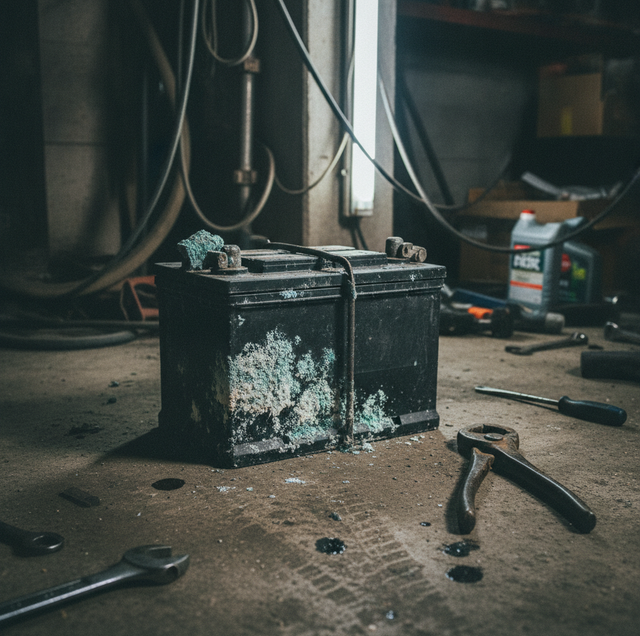
Silence with no dash lights usually means no power is reaching the system: a fully dead battery or a connection problem, such as a loose clamp, a corroded terminal, or a failed ground strap. Before you assume the worst, look at the battery posts. A crust of white or blue-green corrosion, or a clamp you can wiggle by hand, can stop a perfectly good battery from delivering anything, and cleaning and tightening a terminal revives plenty of cars that looked stone dead.
A single loud click when you turn the key is a different story. That click is usually the starter solenoid, the switch that shoves the starter gear into the engine's flywheel. When the battery has just enough charge to energize the solenoid but not enough to spin the starter motor, you get one click and no crank. Most often, that is simply a battery too weak to do the heavy lifting, and a jump sorts it out. But if a strong battery still produces nothing but that same click, the starter motor itself has likely failed, and no jump will fix it.
Rapid Clicking or a Slow, Labored Crank
Rapid machine-gun clicking, often with the dash lights dimming in time, is a battery that cannot hold its voltage under load: each time the starter pulls current, the voltage sags, the solenoid drops out, voltage recovers, and it retries several times a second. That is a classic weak or discharged battery, one of the most jump-friendly symptoms there is. A slow, labored crank is the same message at a different volume, the engine turning lazily, groaning like it cannot spin fast enough to light off. Both point at a battery running low on the muscle it needs.
Why Cold Mornings Expose a Weak Battery
This is where the cold earns its reputation. A battery produces current through a chemical reaction, and, as with most chemistry, that reaction slows as the temperature falls. A battery that delivers its full rated punch in mild weather can lose a large share of it near zero degrees, sometimes close to half. Battery makers rate this with a figure called cold cranking amps, or CCA: the current a battery can push at 0 degrees Fahrenheit while still holding usable voltage. As a battery ages, its real CCA quietly drops, and a mild fall day hides that decline while the first hard cold snap does not.
The cold also works against you from the other direction. Engine oil thickens as it gets colder, so the starter has to fight stiffer oil to turn the engine over. You need more cranking power at the exact moment the battery has less to give, which is why a battery that seemed fine yesterday is dead this morning: it was already marginal, and the cold pulled back the curtain.
None of this is only a winter problem. Heat is just as hard on a battery over the long run, because high underhood temperatures boil off electrolyte and corrode the cells, so a battery cooked through a hot summer is often the one that quits on the first cool morning. The season changes the trigger, but a tired battery can strand you in any month.
The Engine Cranks Fine but Won't Fire
Here, the story flips. If the engine spins over at a healthy, normal speed but never catches and runs, your battery and starter are doing their jobs. The problem lives downstream, in the two things an engine needs beyond just turning: fuel and spark. A fuel pump that cannot build pressure, a clogged filter, tired injectors, a dead ignition coil, or a failed sensor that times the spark can all leave you with a strong crank and no start.
This is the symptom drivers misread most often. A car that cranks vigorously feels almost there, so people keep cranking and call for a jump, but a jump does nothing for a fuel or spark problem because the battery was never the issue. A car that cranks well but will not fire needs to be taken to a shop, which means a tow.
When a Jump Won't Help No Matter What
A jump start does exactly one thing: it feeds a weak or dead battery enough current to spin the starter and get the engine running. It is the right tool only when the battery is the problem, and several common no-starts sit outside that.
- A failed starter: If the battery is strong and you still get a click or dead silence, the starter motor or its solenoid has given out. Jumping a good battery to a dead starter changes nothing.
- A seized engine: If the engine will not rotate at all, and you hear a single heavy thunk or nothing while the dash lights stay bright, the engine itself may be locked. A jump has power to offer, but a seized engine physically cannot turn. That is a tow every time.
- An empty tank: A fuel gauge that reads wrong, or a car parked and forgotten, can simply be out of fuel: the engine cranks and will not fire, and roadside fuel delivery solves that one without a tow.
The thread through all three is the same: the battery is fine, so more battery accomplishes nothing.
Why Repeated Jumps Are a Warning, Not a Fix
If your car needs a jump, starts, then goes dead again a day or a few miles later, do not just keep jumping it. Repeated jump starts almost always mean one of two things, and both need real attention.
The first is a failing alternator. Once the engine is running, the alternator recharges the battery and powers all electrical systems. If it has quit, the car runs only on the charge the jump put in, and when that runs down, the engine dies again, sometimes out on the road. You might see a battery warning light, watch the headlights dim, or feel the car stumble as the electronics starve for power. A car that starts on a jump and then quits is pointing at the alternator, not the battery, and that is a tow.
The second is a parasitic drain. Something is pulling current while the car is switched off (a stuck relay, a trunk or glovebox light that never shuts off, an aftermarket accessory wired wrong), and it flattens the battery overnight. A jump gets you rolling, but the drain empties the battery again by the next morning, and chasing it down is a bench diagnostic job, not a roadside one. A jump is meant to get you to where the real repair happens, not to be the repair.
Dash Lights: Bright, Dim, or Dead
The lights on your dash double as a free voltage gauge. Bright, steady dash and dome lights with no crank point away from the battery, toward the starter, the ignition switch, or a seized engine, because there is clearly power in the system. Dim lights that fade further the instant you turn the key point to a weak battery or a bad connection under load. No lights at all, nothing when you open the door, usually means a dead battery or a broken connection to it. One glance before you crank tells you which half of the map you are in.
Putting the Clues Together
Sort the no-starts by what the car does when you ask it to run. A weak crank, rapid clicking, and dimming lights nearly always trace to the battery, and those are the ones a jump revives. A strong crank that never fires, a single click with a known-good battery, a car that dies right after a jump, or bright lights with no crank at all point past the battery to a starter, alternator, fuel, or engine fault that no amount of jumping will move. When the answer is a tow, the goal is to get the car to a shop without adding damage, which is exactly what a flatbed is for.
Frequently Asked Questions
Plan on 20 to 30 minutes of actual driving, not idling in the driveway. The alternator puts out very little at idle speed, so idling recharges a drained battery painfully slowly, while steady road speed spins it faster and puts real charge back in. Skip the quick stop for gas, since shutting off too soon can leave you needing another jump.
Often, but not always. A deeply discharged battery may need to sit connected to the donor for several minutes before it accepts enough charge to crank, so do not give up after ten seconds. The exception worth knowing: a battery frozen solid in extreme cold should never be jumped, because the internal ice can crack the case or cause it to rupture. If the case looks bulged or is visibly iced, it needs replacement, not a jump.
A quality lithium jump pack rated for your engine size works fine and is often safer, since there is no second running vehicle to mismatch voltages. Check that the pack's peak amp rating suits your engine, as a compact four-cylinder needs far less than a big V8 or diesel. Clip the clamps in order, red to the dead positive first, and give a deeply dead battery a minute on the pack before cranking.
Batteries tend to fail in one step rather than fading politely. A cell can hold just enough capacity to start a warm engine one day and fall short the next, especially once a cold snap raises the amps the engine demands. A parked car also self-discharges roughly one percent a day, and any parasitic draw speeds that up, so a battery near the edge can cross it overnight without a hint the day before.
Treat it as borrowed time. That light means the charging system has stopped keeping up, so the car is running on whatever is left in the battery, often only 20 to 30 minutes of driving before the electronics start dropping out. Switch off the heater fan, radio, heated seats, and any charging phones to stretch the reserve, and head somewhere you can safely stop rather than pushing for home.
Yes, and it is easy to miss. On push-button cars, a dead fob battery can stop the car from recognizing the key, though most let you hold the fob against the start button to override it. A tripped immobilizer or security system can also block the starter entirely, usually with a flashing security or key icon on the dash. Neither is a jump or a tow, so it is worth a look before you assume the battery or starter died.
If the signs point to a tow and not a jump, get the car moving without adding damage. Auto Wreckers Milwaukee Towing & Recycling serves Milwaukee, West Allis, Waukesha, and the surrounding southeastern Wisconsin metro. Call (414) 441-2719.
