
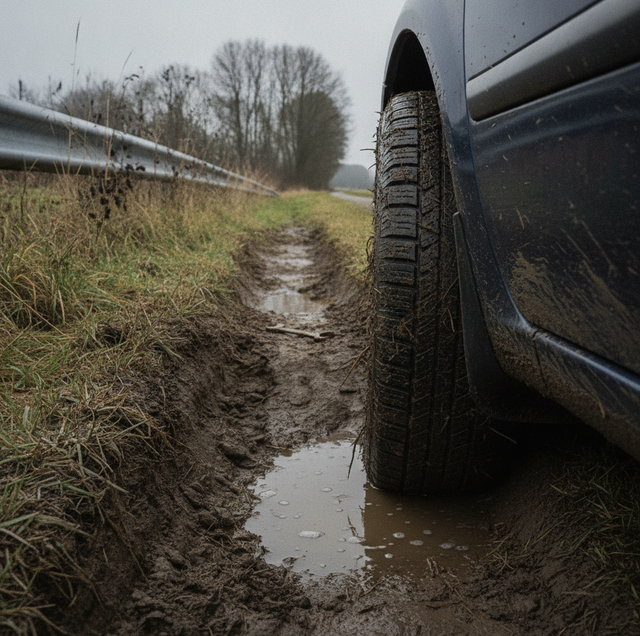
The back tires drop off the edge of the shoulder before you can react. One second, you are on the pavement, the next, the car is tilted nose-down toward the bottom of the ditch, the passenger side sitting lower than the driver side. You press the gas out of instinct, the wheels spin, and the car only settles deeper. The engine revs, mud or packed snow sprays behind you, and nothing moves. What you do in the next few minutes decides whether this is a quick recovery or an afternoon that ends at a body shop.
First Steps When Your Car Slides Into a Ditch
Work through these in order. The instinct to floor it and drive out is the one that costs people the most, so slow down and go step by step.
- Check yourself and your passengers first: Before you worry about the car, make sure no one is hurt. A slide-off is a low-speed event most of the time, but a hard drop or a sudden stop can still cause a strained neck or a bumped head. If anyone is injured or the car comes to rest in a bad spot, call 911.
- Get everyone to safety away from moving traffic: If the car is stable and clear of the lane, staying belted inside is usually safest. If you must get out, use the door on the side away from traffic and move well back from the road, never standing between your car and oncoming vehicles.
- Turn on your hazard lights: Do this even in daylight. A car tilted into a ditch is hard for other drivers to read, and the flashers tell them something is wrong before they are on top of you.
- Stop trying to power out: Once a tire is spinning freely, it is not going to grab. Every extra second of throttle digs the tire deeper, packs mud or snow tighter under the car, and can overheat the transmission, the clutch, or the tire itself. If two or three gentle attempts do not move you, stop.
- Note exactly where you are: Look for a mile marker, a cross street, a house number, or a business sign. Your phone's map can give a road name and a dropped pin. Clear location details are what get a recovery truck to you fast instead of circling the area.
- Call for a winch-out recovery, not just a tow: Tell the dispatcher the car is off the road and stuck, which way it faces, how far down it went, and whether it is on snow, mud, gravel, or grass. That sends a truck rigged to pull you out, not one set up only to hook and haul a car already on the pavement.
Once help is on the way, the safest thing you can do is wait and keep clear of the road. A few hazards are worth knowing about while you sit.
The biggest danger after a slide-off is the traffic lane, not the ditch. Do not stand in or near a live lane to inspect damage or wave down help, and keep passengers back from the road. If the car sits on a steep slope or feels unstable, get everyone out on the uphill side and stay clear in case it shifts. If you run the engine for heat, make sure the tailpipe is not buried in snow, mud, or dirt, because a blocked exhaust can push carbon monoxide into the cabin.
What a Proper Winch-Out Recovery Involves
A straight tow and a winch-out are two different jobs. A tow assumes the car is already where a truck can reach it and hook up. A winch-out is a recovery: the vehicle must be pulled out of its stuck position before it can be towed at all. Solving a ditch with a plain hook-and-chain tow is how bumpers get torn off and quarter panels get creased.
Recovery starts with the anchor points. Most modern vehicles have rated recovery points, usually a frame-mounted tow hook or a threaded recovery eye that screws into a reinforced socket behind a pop-out cover in the bumper. Those are built to take a hard pull in line with the frame. A plastic bumper fascia, a chrome trim bar, a suspension arm, or a tie-down loop meant only for strapping a car to a trailer are not. Pull on those, and they bend, snap, or rip loose, sometimes throwing hardware.
The line matters just as much. A steel winch cable or synthetic winch rope is a static line: the winch reels it in slowly and steadily to draw the car out under control. A kinetic snatch strap does the opposite, stretching and releasing stored energy to yank a lighter vehicle free, which is quick but far riskier if it is rigged to the wrong point or the strap is frayed. Either way, a good operator sets the pull angle so the car climbs out the easiest path, sometimes running the line through a snatch block to redirect it toward the truck.
This is why a rescue from a passing driver so often goes wrong. A chain has no give, so it either tears a mount off your car or snaps and whips back, and a trailer hitch ball can shear off under a shock load and fly off. A helper rarely knows where your rated points are, so the pull lands on a bumper or an axle that was never meant to take it.
Once the car is back on stable ground, it often rides out on a flatbed rather than on its own wheels, especially if a wheel, the suspension, or the drivetrain took a hit going in. A flatbed carries the whole vehicle with nothing dragging, which protects an all-wheel-drive or low-clearance car from more damage on the way out.
How Cars End Up in the Ditch, and How to Stay Out
Slide-offs happen year-round, and the fix is the same in every season: give the tires more room to keep their grip. In cold months, the usual cause is black ice or packed snow on a curve or bridge deck, where the surface looks merely wet but offers almost no traction. The rest of the year, it is a wet road on worn tires, a soft or gravel shoulder that gives way when a wheel drifts onto it, standing water after hard rain, or wet leaves that grease the pavement.
The mechanism is the same in every case. A tire only has so much grip to spend, and once it breaks loose, it will not grab again until it slows. Braking hard or jerking the wheel spends that grip at once. Easing off the gas, looking toward where you want to go, and making small, smooth steering inputs keeps the tires rolling and gives them the best chance to recover before the shoulder pulls you off.
Turning a Slide-Off Into Just a Bad Afternoon
A car in a ditch looks worse than it usually is. The slide itself rarely does serious harm at low speed. Most of the real damage comes from what happens next: spinning the tires until something overheats, or letting an untrained person pull at a bumper or axle. A controlled winch-out on the rated recovery points, followed by a flatbed if anything underneath took a hit, keeps a slide-off from being a bad afternoon instead of a repair bill.
Frequently Asked Questions
Most cars built in the last couple of decades do. Check the trunk next to the spare: many kits include a threaded eye bolt that screws into a covered socket behind a snap-out panel in the front or rear bumper, and the owner's manual shows the exact spot. Many trucks and SUVs instead have fixed tow hooks bolted to the frame under the front bumper. If you cannot find one, tell the operator when you call so they can plan the hookup around a safe pull point.
If the car is stable and out of the traffic lane, staying buckled inside is usually the safest spot, because a car in a ditch is still far more protected than you are standing next to a live road. Two things flip that: get out if you smell fuel or see smoke, and get out if the car sits on a slope or soft edge where it could still shift. When you do leave, climb out the uphill side away from traffic, not the side facing the road, and move well back from the shoulder instead of lingering by the bumper where a second vehicle could clip you. If the car is tilted, the door on the low side will swing hard, so brace it as you go.
You can run it, but check two things first. Make sure the tailpipe is clear of snow, mud, or debris so exhaust does not seep back inside, and crack a window on the side away from the wind. To stretch a low tank, run the engine about ten minutes at a time and then shut it off rather than idling nonstop, which keeps the cabin warm without draining the fuel you will want back on the road.
Often not. All-wheel drive helps you get moving on a slick but level surface, but in a ditch, one or two wheels are usually buried or lifted, and an open differential sends power to the wheel with the least grip, so it just spins. Gently rocking between drive and reverse can work on a shallow shoulder, but hard throttle digs the tire deeper and can overheat the transmission or an AWD clutch pack. If a light rock does not free it, stop and call.
Yes, and it does not always show. The lip of a ditch can bend a control arm or tie rod, knock the alignment off, crack an oil pan, or scrape a skid plate, and a sharp edge can gash a tire sidewall. Have the car looked over before highway speed. A steering pull to one side, a new vibration, a warning light, or fluid on the ground after recovery are all signs to get it checked.
It is riskier than it looks. Most cars have no rated point that can take a sudden shock pull, and anyone standing near the line is in the path if something lets go, so keep bystanders back at least the full length of the strap or chain, and ideally farther. There is also the money side: damage from an amateur recovery is generally on you, not on the good Samaritan who offered to help.
Quick Answer: If your car is off the road and stuck in a ditch, get a proper winch-out from a crew that recovers vehicles without adding damage. Auto Wreckers Milwaukee Towing & Recycling serves Milwaukee, West Allis, Waukesha, and the surrounding southeastern Wisconsin metro. Call (414) 441-2719.
