
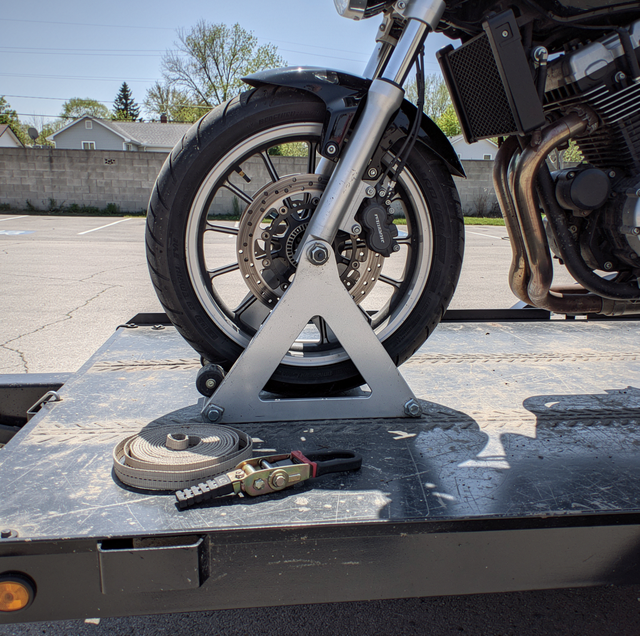
A car towed on two wheels stays upright because its own track width holds it there; lift one end, and the other pair still sits flat and stable on its own. A motorcycle has no such thing. Balanced on two wheels in a line, it stays upright only while someone is riding it, holding it, or something else is bracing it in place. Take away the rider and set it down without support, and it falls over. That single difference rules out a car's wheel-lift hookup and a car tow dolly: both assume the vehicle stands on its own track width while two wheels ride the road, and a motorcycle cannot. On a flatbed, the bike rides with both wheels on the deck, held upright by hardware built for the job rather than by momentum or a rider's balance.
Why Does a Motorcycle Need a Flatbed Instead of a Hook?
A flatbed gives the bike a flat, stationary surface to stand on for the entire trip. Once the bike is rolled or winched onto the deck, a wheel chock, a metal cradle bolted or clamped to the bed, closes around the front tire and holds it centered and pointed straight. The chock keeps the front wheel from turning or sliding; the straps, not the chock alone, keep the bike upright when the truck brakes, turns, or hits a road seam.
A hook-and-chain setup, or any method that relies on dragging a vehicle along on its own wheels, has nothing to hold a motorcycle upright between two contact patches only inches apart. Without a chock and the frame secured to the deck, the first hard stop or lane change could tip the bike and cause it to fall against the truck bed or strap anchors, so a flatbed with a chock and straps is the setup that takes over the rider's job of keeping the bike upright.
Where Do the Straps Go on a Motorcycle Being Towed?
Once the chock has the front wheel locked in place, straps take over the job of keeping the rest of the bike from shifting, and where they attach decides whether the bike arrives the way it left. The frame and the triple clamps, the assembly that holds the fork tubes and turns with the front wheel, are built to carry the bike's full weight and the stress of hard braking, so they can take a taut strap without deforming. A soft-tie loop, a wide loop of nylon webbing wrapped around the fork leg just below the triple clamp, spreads the load over a wider surface than a bare hook or a thin strap, which keeps the tie-down point from marking or cutting into the fork's finish.
Handlebars, mirrors, turn signals, and body panels carry none of that engineering. A handlebar is a lever built to steer a bike weighing a few hundred pounds under a rider's own hands, not to hold the bike's full weight against the sideways pull of a moving truck; strap to it and a hard stop can bend the bar, snap a control lever, or twist the fork in ways the rider never applied by hand. Fairings and saddlebags are shaped for airflow and storage, not load-bearing, and a strap looped around one instead of the frame can crack the mount before the truck ever leaves the curb. A crew ties down to the frame, the triple clamp, or a rear frame point and leaves everything bolted to them alone.
Compressing the Suspension Without Bottoming It Out
Straps do more than stop the bike from tipping sideways; angled correctly, front and rear, they also pull the suspension down slightly and load the tires against the deck, which helps keep the bike from bouncing on its springs every time the truck crosses a pothole or an expansion joint. A small amount of compression firms up that connection to the deck.
That line can be crossed, though. Cinch the front and rear straps down too far, and the fork or shock can run out of travel entirely, leaving the springs bottomed out and the suspension carrying no cushion at all for the rest of the ride; every bump then transmits straight into the frame instead of being absorbed. The target is snug enough that the bike can't rock or shift under braking, with the suspension still able to move a little, not straps pulled to the limit of the ratchet.
What Changes When the Bike Won't Start, Has a Flat, or Came From a Crash?
A motorcycle that rolls freely and steers normally can be walked up a ramp under its own weight and guided into the chock by hand, which is the simplest form of loading. Take away any one of those conditions and the plan changes. A bike with a dead battery or a mechanical no-start still rolls and steers fine, so it's pushed up the ramp rather than ridden, with the same chock-and-strap routine once it's aboard. A flat or badly low tire changes how the bike balances while it's being pushed, since a soft or flat front tire can fold under sideways pressure on the ramp. Extra hands steady the bars during the push instead of relying on the tire to track straight.
Never ride a crash-damaged motorcycle up a ramp to help out: a bent fork can fold on the incline and drop the bike and rider off the side. Leave it where it stopped and let the tow crew load it.
Crash damage is the situation that changes the loading method itself rather than just adding caution. A bent fork, a wheel that's locked or knocked out of true, or a frame that can't be trusted to hold its geometry means the bike can't be walked or pushed at all without risking more damage or a fall. In that case, a winch line pulls the bike up the ramp while the locked wheel rides on wheel skates, small wheeled dollies set under a wheel that won't turn, so the damaged wheel never has to roll to get the bike aboard.
How Should You Describe the Bike to the Dispatcher?
The details a dispatcher needs for a motorcycle differ from those for a car, and naming them up front means the crew arrives with the right gear already loaded rather than improvising at the curb. Saying whether the bike is a cruiser, a sport bike, or a touring model with saddlebags and a full fairing tells the crew roughly how much bodywork needs to be strapped around rather than through, since a touring bike's fairing and saddlebags add bodywork that a stripped-down cruiser does not carry.
Whether the key is with the bike matters for a different reason than it does for a car: a locked steering head can hold the front wheel turned at an angle that fights the chock, so a crew that knows the fork is locked plans to work around that angle rather than discovering it once the bike is already on the ramp. And naming the damage in plain terms- a wheel that won't turn, a bent lever, a cracked fairing- tells the crew whether they're loading a bike that can be walked up under its own wheels or one that needs a winch and skates from the start.
Matching the Load Plan to the Bike's Situation
The bike's condition sets its loading method, and each condition pairs with its own setup:
| Bike's Situation | How It's Loaded and Secured |
|---|---|
| Rolls and steers normally | Walked up the ramp by hand, set in the wheel chock, secured with soft-tie straps at the frame and triple clamps |
| Won't start, but rolls and steers | Pushed up the ramp (not ridden), same chock-and-strap setup once aboard |
| Flat or badly low front tire | Pushed with a second person steadying the bars |
| Locked or crash-damaged wheel | Winch line, with a wheel skate under the locked wheel |
| Bent fork or frame in question | Winched aboard at a slow, steady pull, with nobody standing downhill of the bike |
Frequently Asked Questions
Yes. A trailer built for motorcycles uses the same chock-and-strap method; the limit is the loading ramp, which must be long enough for the frame and exhaust to clear its top edge as the wheelbase crosses it, or a low bike can hang up there.
No. The chock and straps hold the bike upright on their own, and a kickstand left extended can catch on the deck or shear off if the bike shifts even slightly, so it's retracted before the straps go on.
Loose panels, saddlebags, and windshields get checked and either secured flat or left in place only if their mounts are solid, since the vibration of a road trip can crack a mounting tab that was not designed to carry that load.
Yes, when the deck length and combined weight allow it, but each bike gets its own wheel chock and an independent set of straps. They are never tied to each other, so a shift in one bike's position can't pull on the other.
Not in the loading method itself, since it still gets walked, pushed, or winched into a chock the same way. The one added step is to check the battery disconnect before loading a crash-damaged electric bike, since a damaged high-voltage pack affects how safely the bike can be handled.
Tell the dispatcher it is down. A motorcycle on its side can leak fuel from the tank vent and oil from the engine, so keep sparks and cigarettes away from it and leave it where it lies; a bike weighing several hundred pounds is stood up by the crew with enough hands or equipment, not by one person at the roadside.
Order a flatbed motorcycle tow with a wheel chock and soft-tie straps — the bike rides upright, tied at the frame and triple clamps, whether it runs, rolls, or came off in a crash. Auto Wreckers Milwaukee Towing & Recycling serves Milwaukee, West Allis, Waukesha, and the surrounding southeastern Wisconsin metro. Call (414) 441-2719.