
Boat Recovery: What Happens Between the Water and the Road
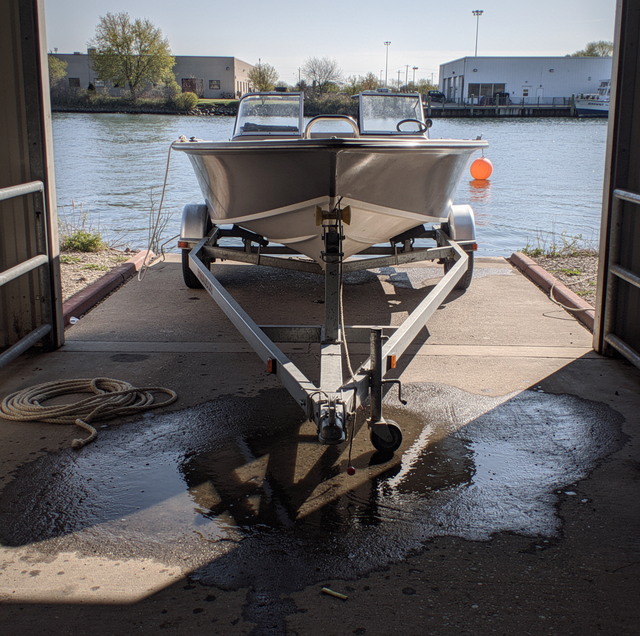
A boat sits fifty feet off a launch ramp, stern low, bow swung downwind. The engine is dead, the bilge is taking water, and nothing about the situation improves on its own. What happens next starts with a phone call, and the questions on that call are not about the engine. They are about the hull, the water under it, and the ground behind the ramp.
Two different jobs hide within the single phrase "boat recovery". One moves a vessel from water onto a trailer. The other moves that loaded trailer down a public road. They run on separate constraints and fail for separate reasons, and where the line falls shapes the questions on your first call, which is why you will hear both lists.
What a Dispatcher Establishes Before a Truck Is Assigned
The intake call is the recovery's first piece of equipment. A response team collects the vessel's specifications and the conditions where it sits, and that pairing narrows the options before anyone drives. Length and beam rule ramps in or out. Displacement rules out trailers. Whether the hull floats rules out entire methods, because a floating boat can be towed to a ramp, whereas a grounded one cannot move until it floats or is lifted onto straps.
The shoreline matters as much as the boat. A crew needs somewhere to put a truck, level ground within reach of the water, and a way out that a loaded rig can take slowly. A ramp that launches a small runabout easily may have no room to swing a longer trailer, and a bank with no ramp turns a retrieval into a lift. None of that is visible from where you are standing.
A Floating Hull and a Grounded One Are Two Different Jobs
Water carries a floating boat the way nothing on land does. Buoyant support spreads along the wetted surface of the hull, so the load at any one spot stays small, and the structure never feels a concentrated point. Take that support away and the same weight has to pass through whatever the hull now rests on: a sandbar, a rock shelf, a pair of trailer bunks, or nylon straps. That is why a crew treats refloating and lifting as two separate operations. Refloating gives back the support the boat was built around. Lifting replaces that support with a handful of contact points, and each one must be placed deliberately.
The equipment follows the same split. Winches, flotation devices, and hydraulic lifts each belong to a different phase of the work: a winch moves a hull horizontally, flotation gives back buoyancy a swamped boat has lost, and a lift takes the weight when the water stops carrying it. A pump often runs before any of the three, because a hull with water in it weighs far more than the same hull when empty.
A damaged hull narrows the choices again. Where the structure is compromised, the work moves to airbags, lifting straps and cradles shaped for that particular boat, so the load spreads across sound structure rather than pressing on a cracked section. Fuel and oil released from a swamped hull are contained by the crew as part of the same operation, which is one reason the assessment happens before anything takes load.
The Line Under Load and the People Near It
Most water-to-land recoveries put a line under tension at some point, and that tension is stored energy. A manufacturer's winching guide describes a winch damper as a device that helps prevent rope recoil if the rope fails, and it places the damper midway between the winch and the anchor point before the rope is under tension. The same guide is blunt about the strap most boaters already own: a recovery strap has no place in a winching operation, because the stretch built into it stores energy the way a winch line does not.
That guidance is written for trucks, not hulls, and the physics travels anyway. The same guidance tells an operator to make their intentions clear to everyone in the vicinity and to declare where spectators should not stand, which is an instruction aimed at the person running the winch. Your part in it is to be somewhere else once the rope comes tight.
A winch line that fails whips back along its path and can strike a helper standing there, so let the recovery operator clear that corridor before load.
Water to Land
The transition itself occurs over a few feet of ramp, where a trailer stops being a road vehicle and becomes a cradle. A hull approaching a submerged trailer has to arrive over the frame in roughly the right place, because it cannot be shoved sideways once it beds down on the bunks. Trailer builders solve that with guides mounted at the front of the frame.
Trailer guides cradle the boat's keel as it loads, aligning it with the trailer so a driver can power on without missing the winch post at normal power. On a recovery, the same geometry has to work with a hull that may have no power at all, so the winch line and the guides do the aligning together, slowly, with a crew member watching the keel, not the bow.
How Long Does a Boat Recovery Take After the Call?
Not as long as the water suggests, and not for the reason most owners expect. The pull itself is often the shortest phase. What takes time is everything that has to be true before it: the intake questions answered, a crew and matching equipment sent out, a staging area found, and the vessel assessed and stabilized where it lies. Each of those runs on information you supply or on a condition nobody controls.
Conditions stretch or shrink the same job. Wind holding a hull against a bank makes a straight pull impossible until the boat is repositioned, and a busy summer ramp with trailers queued behind it costs as much time as cold water costs in the off-season. A better question than how long is when the crew expects to reach the water.
What Changes Once the Trailer Reaches the Road
Once the rig is on pavement, the boat has become a load, and loads answer to rules the water never imposed. Support now comes from the bunks or rollers under the hull and the straps over it. Where the boat's weight sits against the trailer axles changes how the rig behaves at speed, and that balance is fixed the moment the boat comes aboard.
Trailering guidance puts a working figure on it: tongue weight should be 5 to 10 percent of the total load, with too little producing sway and fish-tailing at highway speed and too much making the tow vehicle hard to steer. On a recovered boat, that figure moves because water in the bilge, a shifted engine, or loose gear all change where the weight sits. An operator weighs the loaded rig rather than assuming the trailer's original balance has survived the day.
The assumption worth dropping is that the water is where a boat recovery is won or lost. Hulls come out of lakes and rivers every day on equipment built for it. What goes wrong is usually the stretch that looks routine: a loaded trailer on a public road, balanced by guesswork, carrying a boat heavier and differently loaded than the last time anyone towed it.
Frequently Asked Questions
Yes, and it becomes a different operation. A submerged hull is refloated first, using pumps and buoyancy, because lifting a boat full of water also lifts the water. Expect questions if your boat went under: depth over the deck, what the bottom is, and whether you left gear tied to your hull.
No. A recovery outfit brings transport equipment sized to the hull, and your own trailer is used only if it fits and is roadworthy. Bunk spacing built for one hull shape supports another badly, and a trailer parked for a season may need bearings and tires checked before you tow.
Containment belongs to the crew, before the hull moves. Fuel floats on the water that came in, so a swamped bilge holds a layer. That is why you are asked to stay clear: what comes over your gunwale is more than water you can see.
Draft changes everything. A fixed keel needs deeper water at the ramp and a cradle that carries load at the hull-to-keel joint, not under flat sections never built for it. A stepped mast adds height for the road, so it comes down before your boat travels, and you should expect that step.
Current is the difference that shows first. Moving water continuously pushes a drifting hull, so a crew works with the set rather than against it and often stages downstream of your boat. River banks also limit where a truck can sit and turn a loaded rig, so your access point may end up well away from where you left it.
No, and it is worth knowing before you load your rig. The main bunks or rollers under the running surface carry the boat, while the target bunks only guide the keel into place. The trailer installation instructions are clear about it: target bunks are not meant to be load-bearing, so firm contact with the hull is all that is needed. A boat that came aboard off center can lean on guides never built to hold it, which is worth a look once your own rig is parked.
Call before the boat moves — give the hull's length, its beam, and where it is sitting in the water, because a recovery is planned on that information long before a truck is ever pointed at a ramp. Auto Wreckers Milwaukee Towing & Recycling serves Milwaukee, West Allis, Waukesha, and the surrounding southeastern Wisconsin metro. Call (414) 441-2719.
