
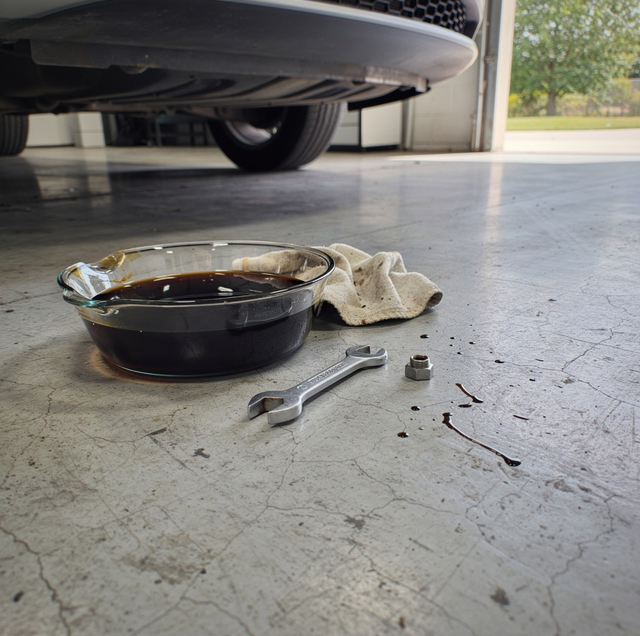
The check engine light comes back on for the second time this year, right after a new rattle appeared under the hood and a puddle appeared under the transmission that wasn't there last month. None of those three things alone means much. Together, on a car with a repair history already piling up, they start to look like a pattern instead of bad luck, and the question shifts from "what's wrong now" to "is this car actually done?"
A car does not have one single endpoint. It has several, one for each major system, and each system has its own line between a repair that brings the car back and damage that no repair reverses. Knowing where those lines sit, system by system, is what turns a guess into an actual answer.
When the Frame or Undercarriage Has Quietly Finished
A car can pass every other test and still be over, because the frame and undercarriage rarely announce their failure the way a dead engine does. The steel that carries the vehicle's weight and holds its shape can be failing while the paint still looks decent and the interior still smells fine.
Whether that steel is a separate frame bolted under a truck's body or the rocker panels and floor pans built into a unibody's own shell, once it has thinned to the point of perforating at a load-bearing point, the vehicle has crossed from "needs a repair" to "needs a new structure," and replacing that structure is rarely worth doing on an older vehicle. A mechanic reading it on a lift does not need rust bulging through paint to make that call: a rail that visibly flexes when the car is jacked at its manufacturer-specified lift point has already lost the stiffness it was built with, and a shop that declines to lift the car at those points at all, or, where the state inspects vehicles, a safety inspection failed over frame or subframe corrosion, is itself the threshold.
Where winters bring salted roads, that undercarriage failure tends to arrive on its own schedule, separate from how the engine and drivetrain are holding up: the brine that keeps the road ice-free all winter works on the frame and rails underneath, where the engine and transmission never meet it, so a truck can idle smoothly and shift cleanly over a frame that is already failing. In places that never salt their roads, that particular gap rarely opens; the undercarriage tends to age at a pace closer to that of everything else, so the end usually comes from a system that wears out with mileage and heat cycles rather than moisture and brine.
A jack or stand set under rotted steel can punch through and drop the car onto whoever is underneath. Do not crawl under a rust-damaged car on a jack; have a shop inspect the frame on a lift.
The Engine's Own Point of No Return
An engine can withstand an impressive amount of neglect and still run, which is exactly why the actual endpoint catches people off guard. The line is internal damage that a fluid change or a sensor swap cannot touch.
A cracked block is the clearest example: coolant and oil start mixing inside the engine itself rather than at a gasket surface, and no seal or additive can reach the split metal. A spun main or rod bearing is a close second. Metal-on-metal contact chews into the crankshaft journal, and once that journal is scored beyond what a machine shop can regrind, the crankshaft is scrap, and on an older engine, a new crank, bearings, and machine work usually end the repair conversation. A snapped timing belt or chain on an interference design lets the pistons and valves meet inside the cylinder, and depending on how many valves bend, that can turn from a belt job into a full teardown.
A mechanic reading a compression test can see this clearly, even when the owner cannot. Healthy cylinders on the same engine typically read within roughly ten percent of each other. A single low cylinder often points to a leaking valve or a worn ring, something a rebuild can address. Two neighboring cylinders reading low together usually means the head gasket between them has failed; low readings with coolant in the oil and a head gasket that tests sound point to a cracked head or block instead, and that is the reading that tends to end the conversation.
Reading a Transmission That Has Already Failed Internally
A transmission that slips, hesitates, or bangs into gear does not automatically mean the unit is finished. Plenty of those symptoms trace back to a fluid level, a worn sensor, or a solenoid that a shop can replace. The point of no return shows up in what the fluid itself is carrying.
A shop that drains a transmission that has actually failed internally reads the story in the fluid before a single gear is inspected. Fluid that has gone dark and carries a scorched smell means the friction material on the clutch packs has burned, a sign that reads worse on a unit that only starts slipping once it is fully warmed up, or on a transmission already carrying one rebuild in its history. Metal flakes or a heavy coating on the drain plug magnet mean the gear teeth or clutch packs have started shedding material into the fluid circulating through the entire unit, including the valve body that controls every shift. Once that debris is in circulation, it keeps cutting new wear into components it passes through, and a transmission in that state does not stabilize on its own. Slipping into more than one gear, or refusing to engage reverse at all, usually indicates internal damage rather than an external sensor issue.
How a Dying Wiring Harness Differs From a Single Bad Part
Electrical trouble on an aging car rarely announces itself as "the wiring is bad." It shows up as one unrelated problem after another: a dash warning that clears itself, a window that works only some days, a module that throws a code and then goes quiet. Chasing each symptom as its own repair is exactly how an electrical problem drags on without getting fixed.
The pattern that separates a single failed part from a dying harness is the number of systems acting up at once. One flaky sensor produces one warning light. A corroded ground point or a section of harness with cracked, brittle insulation can feed bad or intermittent signals to several modules that have nothing else in common. Hence, the antilock brakes, the transmission, and the engine computer all throw codes in the same week for no shared mechanical reason. Road grime and moisture work into connectors and ground straps mounted low on the chassis, corroding the contact points from the outside in; on a car that has spent its winters on salted roads, the same brine that attacks the undercarriage reaches those same connectors and speeds that corrosion along, while a car that has never seen salted roads sees the same contact points go the same way from age and vibration alone, just on a longer timeline.
The point of no return here is corrosion that has worked into the harness itself, under the insulation, rather than sitting at a plug you can clean or a fuse you can swap. Tracing and replacing sections of a corroded harness is slow, specialized work, and once a car needs that scale of rewiring on top of everything else already wrong with it, the electrical system alone can be the reason to stop.
Steering and Suspension Play That Crosses Into a Safety Line
Loose steering and a wandering ride often get written off as something to live with, which is a mistake, because worn steering and suspension components wear gradually, then fail at the moment a joint finally separates, usually while the car is doing something ordinary like changing lanes or braking hard.
A tie rod end or ball joint that has worn past its tolerance lets the wheel move in ways the suspension geometry was never designed to allow, so the car can wander at speed, pull under braking, or wear a front tire unevenly on just one edge. Play you can feel in the steering wheel before the front tires actually respond- more than a small amount of free play at the rim- usually means linkage wear rather than an alignment issue that a simple adjustment can correct. On a car that has spent its winters on salted roads, a subframe or control arm mount weakened by the same brine attacking the frame gives a suspension joint less structure to move within, turning what would be a routine part swap on a solid chassis into a bigger job on a chassis already thinned underneath; on a car that has never seen salted roads, those mounts typically stay sound long after the joint itself has worn out, and the repair stays the routine one.
Frequently Asked Questions
A worn strut usually shows up as a floaty ride or a knock only over a big bump, staying steady the rest of the time. A clunk that shows up over smaller bumps and changes when the steering wheel is turned is a joint moving inside its socket rather than a strut doing its job poorly, which is why a shop checks the ball joints and tie rod ends before it replaces a strut on that complaint alone.
No. The engine computer watches dozens of systems beyond the engine, including the catalytic converter, the transmission, and emissions sensors, so a lit check-engine light is often unrelated to internal engine damage. A code reader identifies which system triggered it before anyone assumes the worst.
A wire itself is simple; what takes time is finding where a harness has failed after the insulation has already corroded. That usually means back-probing the circuit connector by connector along its length rather than swapping one obvious piece, since the corrosion can sit anywhere along the run and only shows itself where the signal actually drops out.
It depends on who wrote it. Some national remanufacturers make theirs transferable to a later owner, while many local shop rebuilds cover only the customer who paid for them, so a used car carrying a rebuilt engine or transmission may come with real coverage left, or none at all, depending on which kind of rebuild it got.
A shop confirming a dead engine typically backs a compression test with a leak-down test, which holds air in the cylinder and reveals whether it is escaping past the rings, the valves, or a cracked head, pinpointing the failure a compression number alone cannot. Ask which test was run and what it showed before agreeing to any repair.
Yes. Brake fluid draws in moisture over months and years even in a system with sound lines, and that trapped moisture lowers the fluid's boiling point; enough heat from hard, repeated braking can flash it to vapor inside a caliper and let the pedal sink gradually instead of failing all at once, a symptom that fresh fluid corrects with no rusted line anywhere in the system.
Once one of these systems is past repair, call before paying for another diagnosis — a car in any condition is picked up with free towing and paid for the same day. Auto Wreckers Milwaukee Towing & Recycling serves Milwaukee, West Allis, Waukesha, and the surrounding southeastern Wisconsin metro. Call (414) 441-2719.