
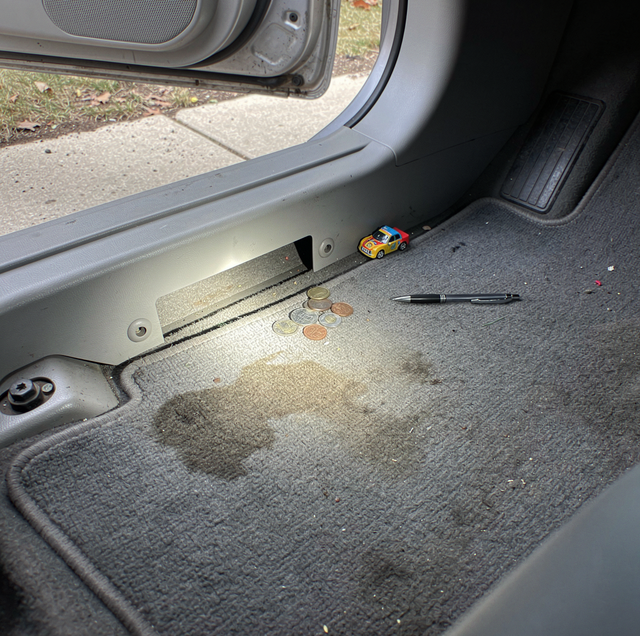
Pull the front seats out of a car on a dismantling floor, and the carpet underneath tells on its owner. Coins, pens, a hair tie, a phone case, a folded insurance card, a child's plastic toy. Now and then a house key, or a garage remote that still opens the garage. Anything loose on the floor moves with the car: what slides forward under braking wedges against the front stop of the seat rails, and what travels back ends up behind the rear mounting bolt; neither spot is reachable from the seat.
That floor is the last time anyone looks. A car sold to a recycler is drained, any parts that still sell are removed, and the shell is baled. Whatever rides in with it stays with it. So make the pass zone by zone with a flashlight, and know why each thing is coming out.
Three Reasons Something Has to Come Out
Everything worth taking out of a car you are junking falls into one of three groups.
The first is what is legally yours to keep or to surrender: plates and the registration decal, permits and passes issued against your name or address, anything carrying an account number, a signature, or a street address. The second is what is worth money separately: parts you bought and installed that were never counted in the car's value as a car. The third is anything whose presence or absence prevents the sale from proceeding on pickup day: signed paperwork, keys, and a class of cargo that a recycler will not accept at all.
The first group matters because of where the car goes next. A junked vehicle passes through several sets of hands before it stops being one: the driver, the intake clerk, the dismantler, a buyer who takes a part off it. Paper with your address travels that chain, and so does a device still paired to something at your house.
The Cabin Holds the Most and Hides the Best
Start at the glovebox, the place people believe they have already checked. Registration and insurance cards, service records with your address, and the owner's manual, which on an old car is really a pouch: the valet key, a spare fob, the wheel-lock socket, sometimes a title for a vehicle you sold years ago.
The console and door pockets come next, and the smallest item in them matters most. A dashcam records to a microSD card that stores every trip you take, including those that begin and end in your driveway.
Then get on your knees. Run the driver's seat fully forward, sweep the carpet and both rails with the light held low so it rakes across the pile, then run it fully back and sweep again. Two positions expose different carpet, and one pass at one setting is how a phone stays lost. Repeat on the passenger side, then reach into the seam between cushion and seat back on every seat.
The visor is its own item. A built-in remote for a garage door or a gated lot keeps working after the car leaves your driveway, still paired to a receiver on your property.
Press and hold the two outer buttons on the three-button HomeLink panel until the indicator flashes rapidly for roughly 20 seconds. That clears every channel the unit holds, so a gated-lot code you forgot about goes with it.
Aftermarket audio is worth real effort. A double-DIN head unit sits in a metal sleeve behind the dash trim and slides out on two U-shaped removal keys that release the spring clips inside. The piece worth saving is the vehicle-specific plug-in wiring adapter behind it, which lets the radio communicate with the car without cutting any factory wiring. An amplifier under a seat or in the trunk comes out with it, on the same fused power lead.
The Trunk and Cargo Area Carry What You Forgot You Owned
Lift the trunk floor. Under it sit the spare, the jack, the lug wrench, the wheel-lock socket if the car has locking lug nuts, and whatever got dropped into the well across a decade: old plates from a car you sold, a tow strap, jumper cables, a first-aid kit. On an SUV, that space is split into side cubbies and under-floor bins.
One item on that list should stay behind. If the wheels have locking lug nuts, leave the socket in the car and tell the driver where it is. It saves the yard cutting four nuts off later.
One category of trunk cargo, though, does not go anywhere near a scrap yard.
A propane cylinder, a sealed gas can, or a pressurized tank left in the trunk rides in with the car. A closed vessel under compression can rupture in a baler or shredder, so take every sealed container out first.
The same goes for a jug of used oil, half-full paint cans, and pool or lawn chemicals; a recycler's drain-and-process line has no step for a sealed container.
Under the Hood, the Battery Is the Only Real Decision
Almost nothing under the hood should come out. A whole-car offer is built on the vehicle arriving complete, so the converter, alternator, starter, and drivetrain are worth more where they sit. Cutting a converter out from under a car on jack stands is dangerous work, and it strips off the part a buyer asks about first.
The battery is the exception. One you replaced recently will start another car, and it comes off with two wrenches and no consequence to anything else.
Then comes the catch. Pull it too early, and you make the car harder to load. A vehicle with an electronic parking brake, an electronic shifter, or a powered steering-column lock needs twelve volts to release into neutral and let the wheels turn. With no power, the brake stays clamped, and the shifter will not move, and a car that will not roll goes onto skates or dollies. Leave the battery connected until the truck is there, and let it come off once the car is positioned.
The fluids stay as well. A recycler drains fuel, oil, coolant, brake fluid, transmission fluid, and refrigerant into separate containment before a car is stacked or crushed, because each goes to a different waste stream. Draining any of it onto a driveway leaves you a stain, a disposal problem, and a car that arrives leaking.
The Exterior and Underside Are Where Money Sits in Plain Sight
Plates come off first, front and rear, screws in your pocket beside them, along with the registration decal if your state puts one on the plate. What happens to them next- surrender, transfer, or keep- is a question for the agency that issued them, and it is worth settling while the car is still in your driveway.
Then walk the glass. A gate barcode, a resident permit, an employee lot decal: each is registered to you or to an address, and each keeps reading at a gate long after the car is gone. A razor blade at a shallow angle, with heat from a hair dryer, lifts them in one piece.
The bolt-ons are where the money sits. Roof rack crossbars, a hitch-mounted bike rack, running boards, a light bar, a ball mount that pulls out of the receiver on one pin. A receiver hitch is bolted through the frame rails and is worth the fight only if you have a use for it. Aftermarket wheels are the other one, and the timing decides it. Break the lug nuts loose while the car is on the ground and its own weight holds the wheel still, then jack it, then bolt a rolling set on in place of what you pulled. Do that days ahead, on your own clock. A car sitting on bare drums will not go up a deck, and a driver working a route has no window to wait while four wheels come off. With no second set to bolt on, the wheels stay.
Road salt corrodes the fasteners on running boards, roof rails, and hitch bolts until they seize, and grit and heat cycling do the same the rest of the year, so soak them with penetrating oil the night before.
Doing the Pass in the Right Order
Order matters because a half-emptied car invites you to put things back in. Bring a box for keepers, a bag for trash, a flashlight, a screwdriver, a socket set with a 10mm in it, a razor blade, and something to kneel on.
Work top-down and front-to-back: visor and mirror, dash and glovebox, console, front seats and rails, footwells, seat backs, the rear bench and its seam, the cargo area, the exterior, hood last. Hood last because the battery decision depends on the truck, and because you want the car able to move while you work around it.
Then photograph each zone with the doors open. A photograph reads differently than the car in front of you, and the second look on a screen catches the strap under the passenger seat your eye edited out in person.
Finally, build the handover stack indoors: the signed title, your photo ID, a bill of sale if you are writing one, and every key and fob you own for the vehicle, including the valet key from the manual pouch and the spare in a kitchen drawer. If the title itself has gone missing, that is a separate conversation to have with the buyer before pickup, and it does not automatically sink the sale. Tell the driver where the wheel-lock socket is sitting, and point out anything that will not roll, steer, or shift.
Frequently Asked Questions
Unpairing your phone does not clear what the car already stored. The contact list, call log, text previews, and any address saved under Home or Favorites in the navigation sit in the head unit's memory until you run a master reset, under the system or settings menu, with the ignition on.
You can, as long as every corner still rolls. The car has to come up a flatbed deck under a winch, and a tire off the bead or a wheel behind a seized brake changes the equipment the driver brings, so say so when you book. Plan for the handling, too: a 17-inch alloy with a mounted tire runs roughly 45 to 55 pounds.
Take it out, and look at it before you assume it goes in another car. Manufacturers mold a date of manufacture into the shell and print an expiration date on the label, running six to ten years from that date, because the plastic and webbing degrade through the heat and cold a parked car cycles through. A seat that rode in a car this old can already be past it.
Less than the schedule suggests. Junk-car removal can run same day or inside 24 hours, so the gap between your call and a truck at the curb can be one evening, and the driver's time on site is measured in minutes because it is a load on a route. If you find something missing after the car is gone, say so that day, while the vehicle is still whole and identifiable at a yard.
They carry more bolted-on property. A toolbox clamps to the bed rails with J-bolts you reach from underneath, a camper shell is held by four to six clamps under the bed lip, and a gooseneck or fifth-wheel hitch bolts through the bed floor into the frame rails, a two-person job on fasteners that years of salt and heat have seized. Van shelving and a bulkhead partition bolt through the floor pan.
Buyers check the conjunction on the ownership line first, and what it means for who signs is set by the agency that issued the title. Make that call before pickup day, with the document in front of you, and read the ownership line to them exactly as printed, punctuation included. If a second signature is needed, collect it in advance; a signature chased down at the curb results in the truck leaving empty.
An empty car and a dispatcher who already knows what is still bolted on make for a short stop at the curb — say what you plan to pull when you book. Auto Wreckers Milwaukee Towing & Recycling serves Milwaukee, West Allis, Waukesha, and the surrounding southeastern Wisconsin metro. Call (414) 441-2719.
