
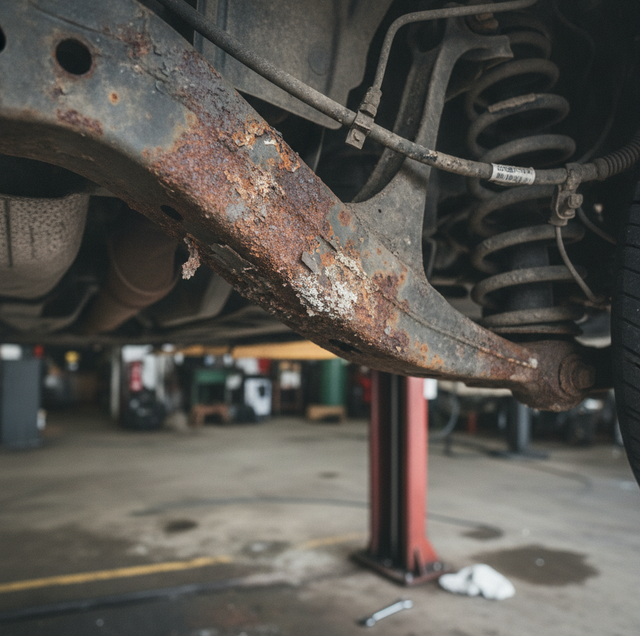
Almost every car eventually crosses a line where the next repair costs more than the car is worth, and the hard part is knowing when you have reached it. Keep pouring money into a car past that line, and you are renting reliability by the month. Let one go too early, and you throw away good years you already paid for. The real question is never whether the car can be fixed, because almost anything can be fixed with enough money. It is whether it should be, and that comes down to four things you can put actual numbers to: the repair bill in front of you, the car's real market value, the state of the frame underneath, and whether the safety systems still work.
That is the question that stops people cold. Is it worth fixing, or is it time to let the car go? The honest answer is not a feeling. It is a short set of numbers and a few hard checks, and once you run them, the decision usually makes itself.
Start With the One Number That Decides Most Cases
Before anything else, find two figures: what the repair will cost, and what the car is actually worth in its current condition. Not what you paid, and not what you owe it emotionally after years of driving it, but the real cash value a buyer would give you today for a car that needs this exact work.
A widely used rule of thumb says that when a single repair costs more than about half of the car's actual value, you are usually better off putting that money somewhere else. A more practical version: if repairs are stacking up faster than a modest monthly car payment would, the old car is quietly costing you as much as a newer one, minus the reliability.
Here is how that ratio tends to play out.
| Repair cost vs. the car's real value | What it usually points to |
|---|---|
| Under about a quarter of the value | Fix it; the car still owes you miles |
| Roughly a quarter to half | Judgment call; weigh mileage, rust, and what else is aging |
| More than half, on a car that is otherwise sound | Fixable, but think hard and confirm nothing else is failing |
| More than the car is worth | Almost always time to junk it |
| Any big repair on a car with structural rust | Junk it, regardless of the ratio |
The last row overrides all the others, and the next section explains why.
When Rust Turns a Repair Into a Junk Decision
Not all rust means the same thing, and knowing the difference is what keeps you from either scrapping a good car or pouring money into a doomed one.
Surface rust is cosmetic. It is the orange freckling on a fender, a bubbled spot under the paint, a rusty tailgate. It looks bad, and it can spread, but it is not holding the car together. A car with surface rust and a strong frame can be perfectly safe to keep driving.
Structural rust is a different animal. The frame, the unibody floor, the rocker panels along the bottom of the doors, and the subframe that cradles the engine and suspension are what carry the loads and hold the car's shape in a crash. When those rust through, the problem is not appearance. It is that the car is losing the structure it depends on.
The mechanism is simple and relentless. Road salt and the brine sprayed on winter roads cling to the undercarriage, and the moisture keeps the metal wet long after the pavement dries. Salt in the cold months does the obvious damage, but road spray, humidity, and trapped mud keep the underside damp the rest of the year too, so the corrosion never fully stops. Water and salt collect in the boxed sections and seams where you cannot see them, and the rust works from the inside out. By the time it shows on the surface of a frame rail or a rocker panel, the metal behind it is often already thin.
That is why frame rot is close to an automatic junk trigger. Welding new steel into a rotted frame or rocker is expensive, and it is only as good as the surrounding metal, which is usually corroding too. A shop may decline the work entirely if the rust is widespread, because a failing frame is a safety problem no repair invoice can promise away. When a rusted structure meets a big mechanical bill, the two together make the decision easy.
The Safety Systems That Are Not Worth Gambling On
Some repairs are optional. A dented door or a dead power window will not hurt you. Others are not the kind of thing you defer, and they belong at the top of any keep-or-junk decision.
Brakes are the clear ones. Rusted brake lines, a failing master cylinder, or corroded calipers are not items you nurse along, and on an older car in a salt region, the steel brake lines are a common and serious rust point. Airbags and their sensors matter just as much and are easy to forget, because they sit quietly until the day you need them. If a car has deployed airbags from a prior crash or warning lights pointing at the restraint system, restoring that system properly can cost a large share of an old car's value.
The rule here is not about dollars alone. A car that needs structural or safety work to be truly safe, on top of whatever brought it in today, has crossed a line that a cheap fix cannot uncross. If keeping it safe costs more than the car is worth, that is your answer.
When the Repairs Just Keep Coming
Sometimes, no single repair is the killer. It is the pattern. A battery in the fall, a wheel bearing over the winter, an alternator in spring, and now a coolant leak. Each bill on its own felt survivable, so you kept saying yes.
Add them up over the last year or two. If the running total is creeping toward what a year of payments on a reliable used car would cost, the old car is not saving you money anymore. It is charging you in installments, with the added tax of the mornings, it will not start, and the trips cannot be trusted to finish. A car that breaks down carries a cost that never shows up on any estimate.
Two repairs sit in their own tier because of price: a blown head gasket and a failed automatic transmission. Either one can run into four figures, and on a high-mileage car, one is often a sign that the rest of the drivetrain is not far behind. When a repair that large lands on a car that has already been nickel-and-diming you, the pattern and the price point the same direction.
What the Car Is Worth If You Let It Go
Deciding to junk a car is not the same as deciding it is worthless. A vehicle that is finished as daily transportation still has real value, and understanding where that value comes from helps you feel good about the call.
There are two ways an old car is worth money at the end. The first is parts. If the body and drivetrain still hold usable components, a working alternator, a transmission that shifts, good tires, catalytic converters, and body panels that are not rotted, the car has salvage value above bare scrap. The second is the metal itself. Every car is a few thousand pounds of steel, aluminum, and copper, and that scrap value is set by weight, by the metals inside it, and by the current commodity market, not by the make and model on the title.
A car with structural rust but a healthy engine can still bring a fair amount, because the mechanical parts and the recyclable metal do not care that the frame is gone. That is the quiet upside of the rust decision: the same corrosion that ends the car's road life does not erase what it is worth as parts and material. A running car generally brings more than a non-runner, a complete car more than a stripped one, and a car with a clean title more than one without, but condition on the road is not the only thing that sets the number.
How to Make the Call
Put the pieces in order, and the decision stops being emotional. Get the real repair estimate and the car's honest current value, and set them side by side. If the repair is a small share of the value and the frame, brakes, and safety systems are sound, fix it and drive on. If the frame or rockers are rotted, if the safety systems need real money, if the repairs have been arriving in waves, or if the bill is closing in on the car's value, the numbers are telling you it is time. Letting the car go is not giving up on it. It is trading a money pit for its remaining worth as parts and metal, and putting that toward a car you can actually rely on.
Frequently Asked Questions
Look up your exact year, make, model, mileage, and trim in an established valuation guide, then adjust down honestly for condition, especially the item you are about to repair. A dealer trade-in offer or a couple of quotes from buyers will also show you the real market number, which usually lands below the clean-condition figure the guides show first.
It depends on where the rust is and how far it has gone, but structural corrosion on the frame, the subframe mounts, or the brake-line area is a common inspection failure in places that inspect for it. Even when no inspection is required, a rotted frame is a safety issue, whether or not a sticker is involved, and a shop can refuse to return a car to the road if it considers it unsafe.
Only if the rest of the car justifies it. A head gasket job is labor-intensive and can reveal additional damage once the engine is open, such as a warped head or scored cylinders. On a low-mileage, rust-free car, it can pay off; on a high-mileage car with body corrosion, that repair usually costs more than the car will ever return.
Yes. Cars are bought in any condition, running or not, and missing parts do not disqualify a vehicle, because much of the value is in the recyclable metal and the components that remain. A non-runner or a stripped car is worth less than a complete running one, but it still has value, and free towing means you are not paying out of pocket to move a car that cannot drive itself.
A clean title makes the process simplest and usually brings the best offer, since it proves you own the vehicle. It is sometimes possible to sell a car without a title under certain conditions, so it is worth asking rather than assuming, but expect to show identification and proof of ownership in some form either way.
Only if your time is worth very little and you have somewhere to keep a half-dismantled car. Parting it out means listing each piece, dealing with a separate buyer for every part, and storing the car while it slowly comes apart in the driveway. When you are done, you still have a stripped shell full of fluids that has to be hauled away, and a shell with the good parts already gone is worth almost nothing. The math only works if the car has one or two in-demand parts and a buyer already waiting; otherwise, the whole-car route nets about the same for a fraction of the effort.
When the numbers say junk it, get the car gone without paying to move it — free junk car removal, same-day or next-day pickup, and cash for it in any condition, running or not. Auto Wreckers Milwaukee Towing & Recycling serves Milwaukee, West Allis, Waukesha, and the surrounding southeastern Wisconsin metro. Call (414) 441-2719.
