
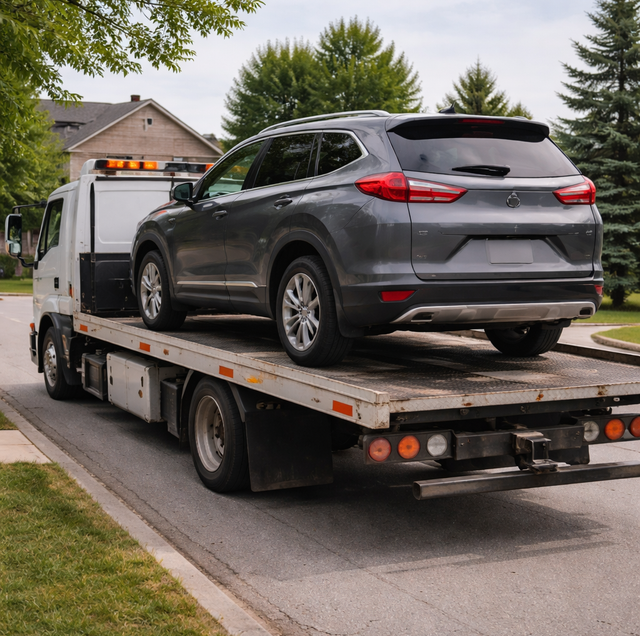
When a car rolls down the highway behind a tow truck with two of its wheels still on the pavement, those wheels are turning the whole time. On a front- or rear-wheel-drive car, a tow operator can often lift the drive wheels and let the other pair spin freely, and nothing important is being forced to move. An all-wheel-drive or four-wheel-drive vehicle takes that option away. There is no truly free pair, because the front and rear axles are tied together through a transfer case or a center differential. Turn one wheel, and you turn the whole driveline, whether the engine is running or not.
That single fact is the reason a flatbed is the default for these vehicles. The drivetrain in an AWD or 4WD car is built to be spun by the engine, with the engine also driving the pump that keeps those parts fed with fluid. Spin the same parts from the road wheels with the engine off, and you get motion with none of the lubrication and cooling that motion is supposed to come with. Do it for a mile or two, and you can turn a routine tow into a transmission or transfer-case rebuild.
What Actually Turns When You Tow a Car on Its Wheels
Inside a modern automatic transmission, a fluid pump pressurizes and circulates the automatic transmission fluid, and that pump is driven off the input shaft, which the engine turns. When the engine is off and the car is dragged along by its wheels, the internals still spin, but now they are being driven backward from the output side while the pump sits dead. The planetary gearsets, bearings, bushings, and clutch packs all rotate without the constant film of pressurized fluid they rely on to stay lubricated and to carry heat away. Parts that expect a wet, cooled environment run dry and hot. Over enough distance, that shows up as scored bearings, glazed clutch material, or a transmission that shifts poorly or fails outright.
A manual transmission is more forgiving in neutral, since its gears are splash-lubricated and nothing is being forced to circulate fluid. But an AWD system layered on top of any transmission still sends power through a transfer case and one or more differentials, and those have their own oil, their own bearings, and their own limits on being spun with no engine behind them. The transmission is only one of several parts at risk.
Why AWD and 4WD Raise the Stakes
The component that makes all-wheel drive work is also the one that gets hurt. A center differential, viscous coupling, or clutch-pack coupling splits torque between the front and rear axles and allows them to turn at slightly different speeds in a corner. It is designed to handle a small, brief speed difference between front and rear, not a permanent one.
Put an AWD car on a dolly with two wheels down, and that is exactly what you create. The two wheels on the ground drive their axle; that axle feeds the coupling, and the other axle is stopped cold because its wheels are in the air. The coupling now sees a full-speed difference for the entire tow. A viscous unit fights that slip by building heat fast, thickening its silicone fluid until it can seize. A clutch-type coupling wears its friction plates. A 4WD transfer case left in an automatic mode with the axles still coupled does the same thing. In every case, you are stressing a part that costs real money to replace, all to avoid sending the right truck.
A Flatbed Takes the Whole Car Out of the Equation
A flatbed, also called a rollback, solves the problem by removing it. The bed tilts down to the road, the car is winched or driven up onto it, and then all four wheels sit on the deck and stay there for the entire trip. Nothing in the drivetrain rotates: the transmission internals are still, the couplings are not slipping, the differentials are not churning. There is no dry spinning, no heat, no wear, because from the drivetrain's point of view the car never moved.
That is why AWD is not the only vehicle that rides on a flatbed by default. Low-clearance cars with front air dams or lowered suspension get the same treatment, because a longer, shallower loading angle and driving aids let them come aboard without scraping the bumper or exhaust. Luxury, exotic, and collector cars ride flatbed for the same reasons plus one more: the owner does not want the vehicle towed by its body or suspension at all. The flatbed is simply the method that touches the least and turns nothing.
Dolly, Wheel-Lift, or Flatbed: What Each One Leaves on the Road
Three common tow methods handle the wheels very differently, and only one keeps all four off the ground.
Wheel-lift: A metal yoke slides under two tires and lifts that axle, while the other two wheels roll on the pavement. It is fast and works well for many front- or rear-drive cars, where the free-rolling pair truly rolls free. On an AWD car it fails the test, because the two wheels left down still turn the whole driveline.
Tow dolly: A small two-wheel trailer that two of the car's wheels drive up onto, leaving the other two on the road. It has the identical drawback for all-wheel drive: two wheels down means the coupling and differentials keep spinning the entire way.
Flatbed: The car is loaded fully onto the deck so none of its wheels touch the road during transport. It is the only one of the three that guarantees the drivetrain stays completely still, which is what an AWD or 4WD vehicle needs.
When the Operator Chooses a Flatbed
A good dispatcher asks how your car sends power to the wheels before a truck is even assigned, because the answer decides the equipment. An operator will reach for a flatbed when the car is badged AWD, 4WD, quattro, 4MATIC, xDrive, or the like, and also in a handful of other situations: a lowered or low-clearance car that would drag on a hookup, a high-value vehicle the owner wants handled with care, a car with crash damage or a locked wheel that cannot roll, and any vehicle that cannot be shifted to neutral because the key is missing or the shifter is dead. When drive type is unknown, the safe call is always a flatbed, since a flatbed can carry a front-wheel-drive economy car with no downside, while a dolly under the wrong AWD car can cost a drivetrain.
What the "Flat Tow in Neutral" Exception Really Means
You may have seen a car rolling four wheels down behind a motorhome and wondered why that is allowed. That is flat towing, and it works only for the specific models a manufacturer approves and only when the owner's manual procedure is followed exactly. Those steps often include a particular sequence to place the transfer case or transmission into a true neutral, and frequently a speed cap, a distance or time limit, or a requirement to start the engine periodically to circulate fluid. It is a planned recreational setup that puts the drivetrain into a special state built to be towed, not an emergency drag down the interstate.
The distinction matters because the two situations look similar from the outside and are not the same underneath. A random AWD crossover pulled onto a dolly is not in any approved neutral state. Its coupling is engaged, its fluid pump is dead, and it is being spun anyway. Unless your specific vehicle is on the manufacturer's flat-tow list and set up their way, four wheels down is not an option, and a flatbed is the answer.
Matching the Truck to the Drivetrain
The whole question comes down to one idea: on an all-wheel-drive or four-wheel-drive car, any wheel left turning on the road turns parts that are meant to be spun by the engine and fed by its pump, and towing that way runs them dry. A flatbed sidesteps all of it by carrying every wheel off the ground. The most useful thing you can do before you ever need a tow is know how your car drives, front, rear, or all four, and say so when you call. That one sentence to dispatch is what gets the right truck sent the first time, and when you are not sure, asking for a flatbed by name is never the wrong move.
Frequently Asked Questions
Distance is only part of the risk; load and speed matter as much. A coupling under constant slip builds heat quickly, and even a few blocks at road speed can be enough to start cooking it, while some wear is cumulative and never reverses. Moving a car a few feet to clear a lane is a different matter from towing it a mile. Note that manufacturers who do permit limited flat towing still spell out a low speed and periodic cool-down stops, which tells you slow and short does not mean safe.
Not in the same way, but there is a catch. A front-wheel-drive car can usually be towed with the front, driven wheels lifted and the rear wheels rolling, which keeps the transmission still. The mistake is dragging an automatic front-wheel-drive car front-wheels-down, which spins the transmission with its pump off and invites the same fluid-starvation damage AWD owners worry about. The rule is to lift the drive wheels, whichever pair those are.
It is still a gamble not worth taking. On-demand and part-time AWD systems tie the axles together through a coupling that can re-engage automatically, and even when the system is "disconnected," it is rarely a true mechanical decoupling; the shafts and coupling still turn with the wheels. Because the tow itself can trigger engagement, the manufacturer's guidance for these cars is almost always to keep all four wheels off the ground.
It depends on the transfer case. Some part-time 4x4 trucks with a manual transfer case can be flat-towed when that case is shifted to Neutral, which is a separate position from 2H or 4H and disconnects the driveshafts, but this is only valid if the owner's manual lists it. Leaving the truck in 2H does not help, because the rear driveshaft still turns the transmission output. When in doubt, the flatbed removes the question.
Then no wheels-down method is safe at all, AWD or not. A locked hub, a bent control arm, a seized brake, or a flat-spotted tire means dragging the car would gouge the pavement and damage the suspension further. Operators handle this by loading onto a flatbed and, when a wheel cannot turn, sliding wheel skates or dollies (sometimes called go-jaks) under the stuck corner so the car can be positioned without forcing the bad wheel to roll.
Usually yes, and often it is required rather than just recommended. Electric motors are frequently coupled directly to the wheels with no clutch to disconnect them, and many EVs cannot be placed in a true rolling neutral without power, so turning the wheels turns the motors. Some also generate current through regenerative braking when rolled. Several manufacturers flatly prohibit flat towing or dolly towing their electric models for these reasons, which makes the flatbed the standard method.
Need an AWD, 4WD, or low-clearance car moved without risking the driveline? Ask for a flatbed by name — all four wheels ride off the ground. Auto Wreckers Milwaukee Towing & Recycling serves Milwaukee, West Allis, Waukesha, and the surrounding southeastern Wisconsin metro. Call (414) 441-2719.
