
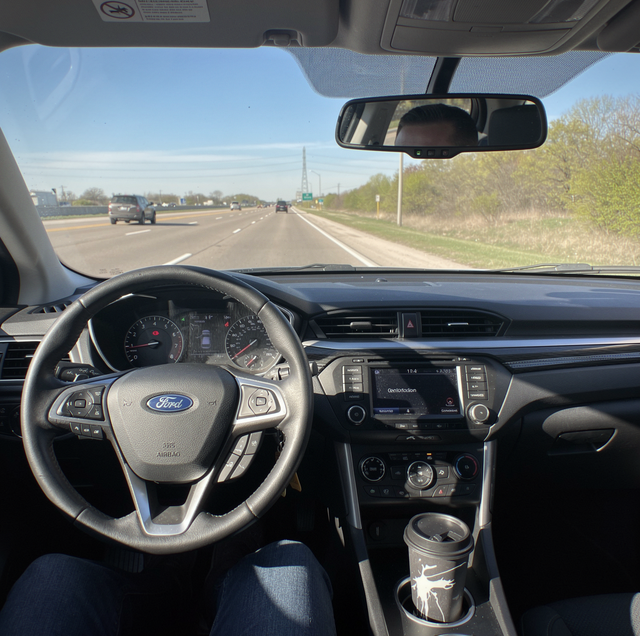
The dashboard light was amber a second ago. Now it's red, the temperature needle is climbing past the halfway mark, and the engine is starting to shudder while traffic streams by at seventy miles an hour a few feet from your door. Or maybe there's no warning at all: the wheel goes heavy, the accelerator stops doing anything, and the car starts drifting like it's rolling downhill in neutral. Either way, what happens in the next thirty seconds decides how safe the next twenty minutes will be.
A highway breakdown is not a repair problem in that moment. It's a positioning problem. Where the car ends up, how visible it is, and how quickly help can find it matter more right now than what actually failed under the hood. That gets sorted out later, on a flatbed or in a parking lot, far from moving traffic.
Get The Car Onto The Shoulder, Not Just Off The Gas
The instant you notice trouble, start easing off the accelerator and steering toward the right shoulder. Don't slam the brakes. A sudden stop in a live lane is one of the more dangerous things you can do on a highway, since the driver behind you has far less time to react than you'd think. Signal if you can, check your mirrors, and let the car's remaining momentum carry it as far onto the shoulder as possible, ideally past the white fog line and toward any barrier or grass beyond it.
If the engine has already died and there's no power steering or brakes left, you'll need more muscle on the wheel and more distance to coast to a stop, so start the move earlier rather than later. If you truly cannot reach the shoulder before the car stops, an interstate median or the paved area beside an entrance or exit ramp is a reasonable second choice. Getting off the traveled lane always takes precedence over finding the perfect spot.
Turn On Your Hazards Before You Do Anything Else
As soon as the car is moving toward the shoulder, hit the hazard button. Don't wait until you've stopped, don't wait until you've made a phone call, don't wait until you've figured out what's wrong. Hazards tell every driver behind you that something has changed, and on a highway that warning can be the difference between a car swerving in time and one that doesn't. If you're carrying road flares or a reflective triangle, that's the moment to think about them too, but hazards come first, always.
Keep them running the entire time you're stopped, even if it feels like it might drain the battery. A depleted battery is a far smaller problem than being struck by a car that never saw you.
Exit From The Passenger Side, Away From Traffic
Once you're stopped and the hazards are on, resist the instinct to just step out the driver's door as you would in a driveway. On a highway shoulder, that door opens directly into the lane traffic is using, sometimes just a few feet from cars moving at full speed. If it's safe to do so, and especially if anyone else is in the car, exit from the passenger side instead, moving away from the roadway rather than into it.
Once everyone is out, move well past the guardrail or onto the grass beyond the shoulder if one exists. Standing next to the car, leaning on the trunk, or trying to flag someone down from the roadside puts you exactly where a passing vehicle is most likely to end up if it drifts. It feels safer to stay close to your car. It usually isn't.
Call For Help With A Mile Marker Or Exit Number
Once you and any passengers are in a stable place, make the call. Whether that's a towing dispatcher, roadside assistance, or emergency services, the single most useful thing you can give them is your exact location, and on a highway that means a mile marker, an exit number, or the direction of travel rather than a street address. Most interstates post small green mile marker signs every mile, and exit signs are visible well before the ramp itself. If you passed one recently, say so.
Dispatchers use that information to route a truck efficiently and to tell you roughly how long the wait will be. A vague description like "somewhere past the big bridge" can add real time to a response that would otherwise take minutes. Think of the mile marker the way a street address works for a house call: without it, help is searching a much wider area than it needs to.
What Actually Causes Breakdowns Like This
Highway breakdowns don't happen evenly across the year, and the causes shift with the seasons in ways that are worth understanding even though they don't change what you do in the moment. Cold snaps are hard on a car in two ways: they thicken engine and transmission fluid, so components have to work harder to move, and they push a battery that's already marginal past the point where it can turn the starter over. That's why no-start and stranded-vehicle calls tend to climb sharply once temperatures drop for an extended stretch. A weak battery that starts a car fine at seventy degrees can fail completely at twenty, the same way a worn rope holds under light use but snaps the first time real weight is put on it.
Winter brings a second mechanism that's slower and less obvious: road salt and slush work their way into brake lines, exhaust systems, and undercarriage components through repeated exposure, accelerating rust and corrosion that eventually show up as a mechanical failure with no obvious warning. This isn't only a cold-weather story, though. Summer heat strains cooling systems and belts, and a car left idling in traffic or parked with the engine running for long stretches can overheat and strand a driver just as fast as a January cold snap can kill a battery. Add rain and softened, waterlogged shoulders to the mix, and you get an entirely separate set of hazards, from reduced traction while merging onto the shoulder to a soft edge that makes it harder to get fully clear of the lane.
What To Do While You Wait
Once the call is made, there isn't much left to do except stay visible and stay patient. Keep hazards running, stay clear of the roadway, and if you're waiting after dark or in low visibility, keep an eye out for the tow truck's approach so you can flag it in without stepping back toward traffic. Resist the urge to pop the hood and start investigating unless you're already safely off the shoulder; diagnosing anything on a live highway edge isn't worth the risk.
If the wait stretches longer than expected because of weather or traffic elsewhere, that's usually a function of how many other drivers are dealing with the same conditions you are. A stretch of freezing rain or a sudden heat spike can put a lot of vehicles on the shoulder at once, and dispatchers generally work through calls in order of safety risk rather than strictly by who called first.
What Happens When The Tow Truck Arrives
For most highway breakdowns, the truck that shows up is doing one of two things: giving your vehicle a quick assist to get it running again, like a jump start, a fuel delivery, or help with a flat tire, or hooking it up for a tow to a shop, a storage yard, or wherever you need it taken. Heavier vehicles, or ones that have left the roadway entirely, sometimes need a winch-out or a flatbed rather than a standard hookup, and a truck involved in a genuine accident recovery may need different equipment altogether.
Cost for a call like this is generally determined by a handful of factors: how far the truck has to travel, the distance to the drop-off point, the vehicle's size and weight, and whether specialized equipment like a flatbed or winch is required. None of that gets sorted out roadside, and it shouldn't need to be. Your job in the moment is limited to getting clear, staying visible, and giving a location that's easy to find. Licensed, insured operators running 24/7 dispatch handle the rest.
Frequently Asked Questions
Getting out and moving well clear of the shoulder, behind a guardrail or onto the grass if one is available, is generally safer than sitting inside a stopped car on a highway edge, since a stationary vehicle on the shoulder is still at risk of being struck. If exiting isn't safe because of extremely narrow shoulder space or heavy traffic right at the edge, staying belted in with hazards on and doors locked is the fallback, with everyone positioned as far from the driver's side as the car allows.
Some stretches of highway have narrow or nonexistent shoulders, particularly near bridges, tunnels, or interchanges. In that case, aim for the nearest exit ramp or a paved median rather than forcing the car onto a strip of grass or gravel that isn't built to support it. Getting even partially onto a wider section, or fully off at the next ramp, is safer than stopping on a sliver of shoulder that leaves the car's body still partly in the lane.
Waving down strangers on a highway shoulder isn't recommended, since it puts you in the open right where you're most exposed. A better move, if you want to signal distress without stepping toward the road, is to raise the hood or tie a piece of cloth to the antenna or side mirror, both of which are widely recognized as calls for help without requiring you to move any closer to traffic.
A car that dies completely on the shoulder is usually a job for roadside assistance rather than a wait-and-see approach. Jump starts, lockout help, and fuel delivery are common quick fixes for a car that's stopped but not seriously damaged, and a dispatcher can often tell over the phone whether a quick assist is likely to work or whether the vehicle needs a tow instead.
Beyond the mechanical causes of a breakdown, fog, heavy rain, or early winter darkness can slow a truck's approach and make it harder for the driver to spot your exact location, even with a mile marker in hand. Turning on hazards early and keeping headlights on, rather than switching everything off to save the battery, gives an approaching truck a much better chance of spotting you before it's right on top of your position.
If conditions change after your first call, for example, you manage to coast to a nearby exit ramp, or a wider pull-off a short distance away, calling back with the update matters more than most drivers assume. Trucks are routed to the coordinates or mile marker given at the time of the call, and a driver who has moved without updating dispatch can end up waiting far longer than expected while the truck searches the original spot.
Save this number for the next time a car stalls on the highway — a licensed, insured crew is a call away for towing and roadside recovery in any weather, day or night. Auto Wreckers Milwaukee Towing & Recycling serves Milwaukee, West Allis, Waukesha, and the surrounding southeastern Wisconsin metro. Call (414) 441-2719.
